Blog · crm-hygiene
Is your CRM data clean enough for AI recommendations?
Rarely across the whole CRM. Test it per recommendation: measure the fields the model reads, then score its advice against outcomes you already know.
of SVPs and VPs have acted on AI advice they later suspected was wrong due to bad data
Validity, 2026Most B2B teams can't yet trust AI recommendations drawn from their whole CRM. You don't need a perfect database, though. You need to know which recommendation you want, which fields it reads, and whether its past advice would have been right.
Is most CRM data ready for AI today?
No: by its owners' own account, most CRM data isn't ready to support AI recommendations. Just 21% of marketers in Validity's 2026 survey say their CRM data is “very well prepared” to support AI.↗ A year earlier, 76% of CRM users told Validity that less than half of their CRM data was accurate and complete.↗ Only 35% of sales professionals completely trust the accuracy of their data.↗
The cost is already showing up in revenue. Of the organisations Validity surveyed in 2026, 62% report losing revenue directly because of poor CRM data quality.↗ In the 2025 survey, companies lost an average of 16 deals per quarter to poor data.↗
Don't read the two Validity editions as a trend line. The 2025 survey asked 602 CRM users in the US, UK and Australia; the 2026 survey asked 500 marketers across 5 countries.↗↗ The questions differ too. What they share is the direction: the people closest to the data don't trust it much.
Why does bad data make AI advice riskier?
Bad data makes AI advice riskier because the output looks finished even when the input isn't. A rep who sees a blank industry field knows to check it. A model that reads the same blank field still returns a ranked list, a score or a next step, written with the same confidence as a good one.
Leaders are acting on that confidence. In Validity's 2026 survey, nearly 78% of C-suite respondents and 92% of SVPs and VPs say they have acted on an AI recommendation they later suspected was wrong because of bad underlying data.↗ The same survey found 2 in 3 organisations handed more marketing decisions to autonomous AI agents in the past year.↗ More delegation on the same data means more wrong calls, and fewer of them get checked.
Senior marketers act on AI advice far more often than they trust the CRM data behind it.
Data behind this chart
| Item | Value |
|---|---|
| SVPs and VPs who acted on AI advice they later suspected was wrong | 92% |
| C-suite who acted on AI advice they later suspected was wrong | 78% |
| Organisations losing revenue to poor CRM data | 62% |
| Marketers who say their CRM data is very well prepared for AI | 21% |
At high ACV, the damage doesn't average out. You sell to a short, named list of accounts, so every call counts. A wrong account score sends reps after the wrong buying group for weeks, and a wrong deal-risk flag pulls attention from the deal that was actually slipping.
Readiness depends on the recommendation you want
Whether your data is clean enough depends on the recommendation, because each one reads different fields. An account-scoring model leans on firmographics and engagement. A deal-risk model leans on stage history, close dates and activity. A renewal or expansion prompt leans on product usage and support history.
So a CRM can be ready for one use and badly wrong for another. A database with tidy firmographics and messy stage history can score accounts well and forecast badly. Asking “is our data clean?” in general gets you a general answer, and a general clean-up project that never finishes.
| Recommendation | Fields it reads | What goes wrong on messy data |
|---|---|---|
| Account scoring and prioritisation | Industry, company size, country, engagement activity, open deals | Duplicates split one account's engagement across records, so in-market accounts score low |
| Deal risk and forecast | Stage history, close dates, amounts, activity, contacts on the deal | Skipped or backdated stages make healthy deals look risky and stalled deals look fine |
| Next step for reps | Last activity, owner, lifecycle stage, contact roles | Stale owners and missing roles send the task to the wrong person |
| Renewal and expansion prompts | Product usage, support tickets, renewal date, contract value | Usage not linked to the right account makes silent churn look healthy |
The answer engines list the right dimensions of data quality: accuracy, completeness, consistency, freshness and uniqueness. What they skip is the link from a dimension to a decision. Duplicates matter a lot for account scoring, because they split one account's engagement across several records. They matter much less for a deal-risk model that only reads open opportunities. Start from the decision, then check the dimensions that decision depends on.
How do you test CRM data before you trust the AI?
Test it on one recommendation at a time, with the bar agreed before you look at the results. The steps below take a scoped slice of the CRM, not the whole database.
- 01Step 1
Pick the recommendation
Name the decision it changes and who acts on it.
- 02Step 2
List the fields it reads
Include inferred inputs such as activity dates and contact roles.
- 03Step 3
Measure those fields
Fill rate, duplicates, stale records and free text where picklists belong, on recent records.
- 04Step 4
Backtest the advice
Compare past recommendations with what happened, and trace each miss to its inputs.
- 05Step 5
Set the bar, then decide
Agree what it must beat before you look. Act where it holds up; fix the fields behind the misses.
Pick the recommendation and the decision it changes. “Which accounts should reps work this week?” is testable. “Use AI in sales” isn't. Write down who acts on the output and what they do differently.
List the fields it reads. Ask the vendor, or read the model's input list if you built it. Include the fields it infers from, such as activity dates and contact roles, not just the obvious ones. If nobody can tell you what the model reads, that is your first finding.
Measure those fields on recent records. For each field, check how often it's filled, how often the record is a duplicate (accounts by normalised domain, contacts by lower-cased email), how many records haven't been touched in a year and whether picklists are used or free text has crept in. “Enterprise”, “ENT” and “Large” in one segment field are separate segments to a model.
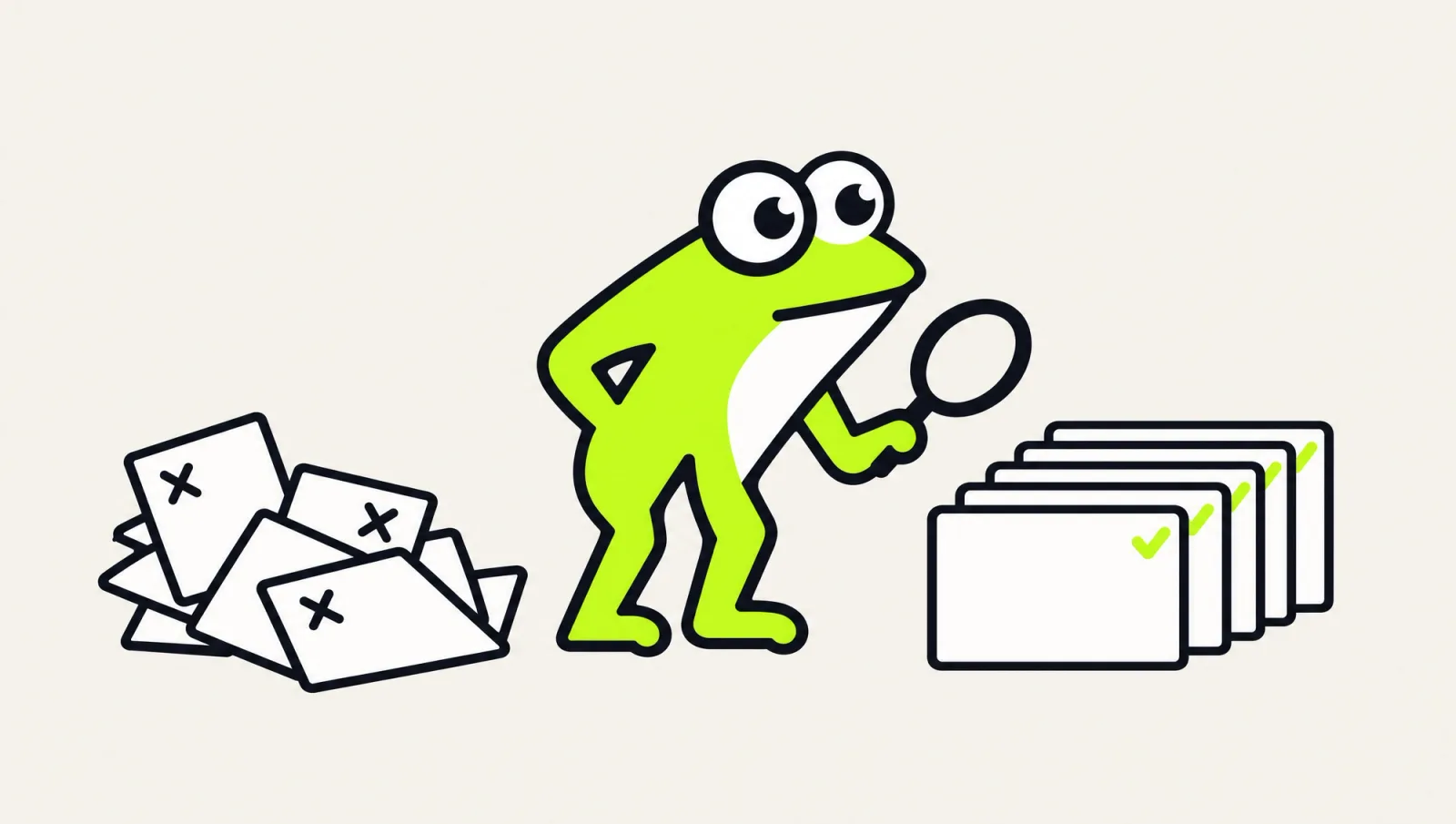
Backtest the advice. Take a sample of past recommendations, or rerun the model on records as they stood a quarter ago. Compare what it said with what happened: won, lost, churned or expanded. Look at the misses and trace each one to its inputs.
Set the bar, then decide. Before you look at the results, agree what the recommendation has to beat. The usual benchmark is your reps' current judgement on the same accounts. If it beats that, let it order the list and keep a person on the first touch. If it doesn't, fix the fields behind the misses and test again.
This is the same discipline as any GTM change: baseline first, then report the after-number against it. The GTM audit checklist covers where CRM hygiene sits among the other areas worth checking.
What should you fix first when the data fails?
Fix the fields the recommendation reads, at the point of entry, before you clean anything else. A full-database clean-up takes months and the data decays while you work. A scoped fix on the fields that matter can be tested again within the quarter.
In practice, that means a short list:
- Required fields and picklists at creation. Records created tomorrow should arrive complete. Otherwise you clean the same fields every month.
- Deduplication on the scored objects. Merge duplicate accounts on normalised domain and duplicate contacts on email, so engagement lands on one record.
- Stale records flagged and set aside. Mark contacts with no activity and no update for a year, and keep them out of the model's inputs until someone verifies them.
- An owner for every integration. Sync errors break data quietly. Someone should see them the day they happen.
- Monitoring instead of one-off projects. In Validity's 2026 survey, 39% of respondents named continuous automated monitoring as the capability they need most.↗
AI can help with this work: matching duplicates, normalising job titles, filling firmographics from a data provider. Point it at a filtered list first, not the whole database, and review a sample of its changes before it writes to the CRM. Keep a person between the recommendation and the action until the backtest holds up for a full quarter. If you use AI to find in-market accounts, the same test applies to the buying signals it scores.
In practice
How we do it at panelhop
The Panel Check (GTM audit · 2–3 weeks) scores CRM hygiene from your own records: duplicate accounts by normalised domain, duplicate contacts by email, stale records and required-field completeness on recently created records. We tie each score to the decisions it feeds, so you leave knowing which recommendations your data can support today and which it can't.
Signal Desk (in-market accounts, weekly) scores accounts on buying signals and puts them in your CRM with a brief your rep can act on. A person reviews every batch before it reaches your team. AI drafts, people approve.
Questions buyers ask about this
Do we need to clean the whole CRM before we use AI?
No. Clean the fields that one recommendation reads, on the records it acts on. A full clean-up takes months and the data decays while you work; a scoped one can be finished and tested before the quarter ends.
Can AI clean our CRM data itself?
It can help with deduplication, normalisation and enrichment, but it shouldn't change records unreviewed. Run it on a filtered list, check a sample of its changes and keep a log so you can reverse them.
How do we tell whether a bad AI recommendation came from bad data?
Trace the recommendation back to the fields it used and check them against the record's history. If a stage, owner or industry value was missing or out of date, the data is the likely cause. If the inputs were right, look at the model.
Should reps stop acting on AI scores until the data is fixed?
No, but they should treat each score as a draft. Let the score order the list and have the rep check the record before the first touch. Widen what the score decides once its backtest holds up.