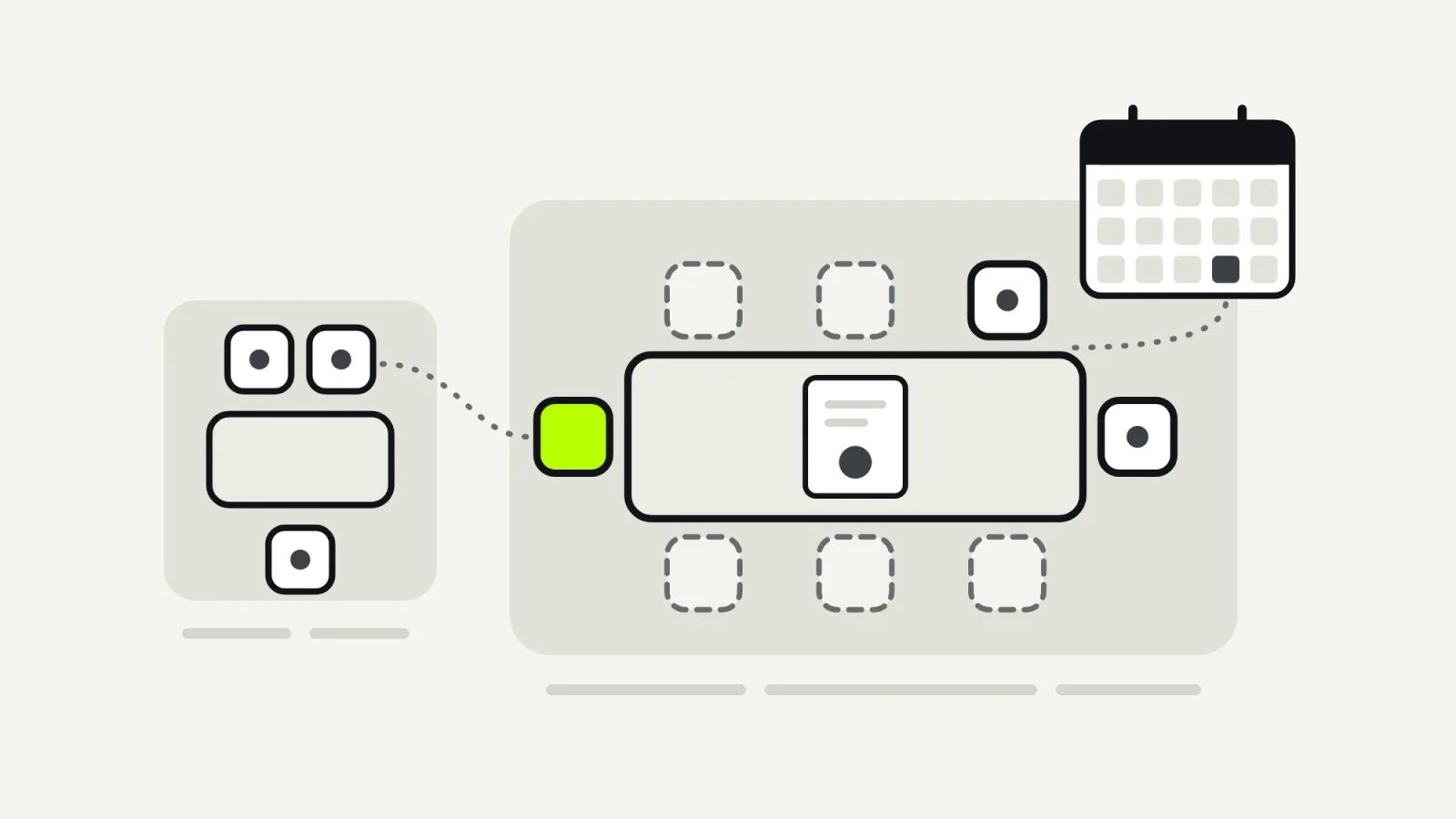
higher win rates when decision-makers are involved in the first 2 sales stages
Ebsta x Pavilion, 2025An approval opens a new deal with a new buying group
When a customer wins approval for a bigger programme, the expansion it opens is a new deal, even though the customer already pays you. The approval puts money in a new budget with a new owner. The people who bought your first product answered a smaller question, and the larger one is mostly decided by people who weren’t in that room.
The larger scope pulls in the owner of the approved budget, procurement, finance, IT, security and the team that will run the result. Where a board, council or regulator gave the approval, someone who answers to it joins too. Forrester counts 13 internal stakeholders and 9 external influencers in a typical buying decision, and procurement is a decision-maker in 53% of buying cycles.↗ Your champion is one of those people.
The approval also starts a clock. The vendor that wins the programme’s main contract can offer your scope inside it, and once that bundle is signed, reopening it means reopening the main contract. So the expansion has a lock date: the day the scope is fixed in someone else’s contract. Every date in your plan counts back from it.
Route the approval as a buying signal to a named owner
Route the approval to a named owner on the day it is published, with a first action and a due date. Few buying signals are stronger: an approval is dated, often public and tied to money.
The approvals that open expansions move budget or scope: a board or council vote on a programme, a regulator’s order, a capex approval, a funding award or a budget for a new site. Track them at your customers as closely as at your target accounts, in meeting agendas and minutes, regulatory dockets, investor updates and press releases.
The owner is the person who will run the expansion, usually the account manager. On day 0 they log the approval on the account and open an expansion opportunity. Within 2 days they answer 4 questions:
- What exactly was approved: scope, budget lines, schedule and conditions?
- Is your scope in it, and under whose name?
- Who owns the approved budget?
- When is the scope fixed: at the RFP, the vendor selection or the contract signature?
The last answer is the lock date. Put it on the opportunity as its key date.
- 01Day 0
Route the approval to a named owner
Log it on the customer’s account, open an expansion opportunity and set the first action with a due date.
Same day - 02Days 1–2
Read the approval and set the lock date
Find what was approved, who owns the budget and the date another contract fixes the scope.
2 days - 03Week 1
Map the bigger buying group
List the roles the new scope needs and mark who is engaged. The champion makes one introduction, to the new budget owner.
1 week - 04Weeks 1–2
Ask procurement for the contract route
An option, an amendment, a new purchase or a place inside the main contract. The answer sets the remaining dates.
2 weeks - 05Weeks 2–4
Bring in finance and regulatory affairs
Settle which budget line pays and how the cost is treated, before the business case.
3 weeks - 06Before the lock date
Submit, then pass the commit gate
Leave procurement time to review. Count the deal in commit only when the budget owner, procurement, finance and any regulatory role are engaged and the route is confirmed in writing.
We think an approval that sits a week in an alert feed or a shared inbox is already late, because the vendors chasing the main contract talk to the programme owner from the first day. So name the owner in the routing rule, before the signal arrives.
Who do we bring in? Map the bigger buying group
Bring in every role that decides on the bigger scope, mapped from the approval rather than from the people who bought your first product. Start from the first deal’s record: for each role, note who held it then and who holds it now. Then add the roles the new scope needs.
Mark each role kept, new person or new role, and engaged or not. Engaged means a two-way exchange in the last 90 days. Coverage is engaged roles divided by required roles. Give each role an owner on your side who can answer its first question, a first ask and an engage-by date counted back from the lock date.
Finance and whoever answers to the approver are the people most teams meet too late. They decide which budget line pays and whether your cost fits what was approved, and an approval doesn’t take them out of the deal. At an investor-owned utility their objection is structural: on-premises software is usually a capital expense the utility can put in rate base and earn a return on, while cloud SaaS is usually an operating expense passed through without one.↗ By Panelhop’s estimate, a utility’s buying group has 6–12 people on deals above €100k, and its finance and regulatory roles can stop the deal.↗
So bring finance and regulatory affairs in during the first month, before the business case. Ask 3 questions: which budget line pays, whether the approved programme already covers your cost and who defends that cost to the regulator. Give each an owner who speaks their language: a value lead or your CFO for finance, someone with rate-case experience for regulatory affairs. Don’t promise that your subscription can be capitalised. That is their accountants’ call, and the regulator’s.
Keep the expansion out of commit until the budget owner, procurement, finance and any regulatory role are engaged and the route is confirmed in writing. Report its coverage every week, like any open deal.
Can we expand our contract by amendment? Ask procurement first
Sometimes: procurement and legal decide which route is open, so ask them in the first week. Their answer sets every other date in the plan. There are 4 routes, and the contract you already have narrows them.
| Route | When it fits | Who decides | Ask in the first week |
|---|---|---|---|
| Option in the current contract | The first contract priced the next module as an option | Procurement and legal | Is the option still open, and at what price and term? |
| Amendment or change order | A small change that keeps the contract’s nature | Procurement and legal, under the buyer’s rules | Does this scope fit the contract, or is it a new purchase? |
| New purchase | A large or new scope, or rules that require competition | Procurement, the budget owner and finance | Will it be tendered or bought directly, and on what dates? |
| Inside the main contract | The buyer wants one contract for the whole programme | The programme owner and procurement | Can we be named for this scope in it, and by when? |
Public and regulated buyers have little room. In the EU, the procurement rules for utilities let a contract change without a new procedure only in listed cases. The 2 that matter here are an option or review clause in the original documents, and a change worth less than both the EU threshold and 10% of the initial contract value for services and supplies.↗ A change that extends the scope considerably counts as substantial.↗
Take an example: a first contract worth €600k over its term. A change stays under the 10% line only up to €60k, so a new module priced above that needs another route.↗ In the US, a municipal utility follows state and local purchasing rules and a private company its own policy. Either way, ask procurement before you draft anything. This summary isn’t legal advice.
The best fix comes before any approval: write the next module into every first contract as a priced option. Panelhop’s research on metering vendors names the leak it closes: add-ons arrive one budget at a time because the original contract lacks pre-priced options.↗
Your champion opens the door; a dated plan carries the deal
We think the champion who bought your first product should open the door to the expansion, not carry it. A plan that names who talks to whom, and by when, carries it.
We have 3 reasons. The champion rarely owns the new budget, because the approval put it with a programme owner. The champion has no standing with procurement, finance or regulatory affairs on a scope they won’t run. And a plan that lives in one person’s head leaves with that person.
The data points the same way. In Gong’s analysis of 1.8M deals, multi-threading lifted win rates by 130% on average in deals over $50k.↗ Across 655,000 opportunities in Ebsta and Pavilion’s benchmark, win rates rose 55% when decision-makers were involved in the first 2 stages of the sale.↗
So ask the champion for 3 things: an introduction to the new budget owner, the first product’s results in the customer’s numbers and a place in the first meeting. Your owner does everything else. We think relayed questions come back late and without numbers, so never ask the champion to carry finance’s questions or sell the scope for you.
How does an expansion plan run after an AMI approval?
It counts back from the lock date, as this illustration with a fictional vendor, utility and dates shows. A meter data analytics vendor sells revenue-protection analytics to an investor-owned utility on a 3-year subscription.↗ On day 0 the state commission approves the utility’s advanced metering (AMI) programme.↗ The AMI vendor’s proposal includes its own meter data management (MDM), the layer that validates, estimates and edits meter reads and passes billing-ready reads to billing.
Utility sales cycles are long: by Panelhop’s estimate, 9–15 months for new software, and up to 36 at a US investor-owned utility.↗ Rollout follows an AMI approval in 6–12 months, also by Panelhop’s estimate, and MDM, analytics and billing integration are bought alongside it.↗ In Panelhop’s model of a municipal utility approving AMI, 5 of 7 roles can veto, and the meter services manager, typically the vendor’s champion, has no veto.↗
The account manager gets the order on day 0 and opens an MDM expansion opportunity. On day 2 the filing shows the AMI contract is due for signature on day 120, with its statement of work frozen 3 weeks earlier, so the lock date is 120 − 21 = day 99.↗ Procurement needs 4 weeks to review an amendment, so the proposal goes in by 99 − 28 = day 71.↗
The MDM scope needs 8 roles, and 2 are engaged from the analytics deal: the champion and IT. Coverage is 2 ÷ 8 = 25%.↗
| Role (illustration) | In the analytics deal | In the MDM expansion | Engaged now | Our owner | Engage by |
|---|---|---|---|---|---|
| Analytics lead (champion) | Bought and runs it | Introduces the budget owner | Yes | Account manager | Day 5 |
| AMI programme director | Not involved | Owns the approved budget | No | Account manager and our CEO | Day 10 |
| Procurement and legal | Signed the subscription | Decide the contract route | No | Account manager and our contracts lead | Day 10 |
| Finance | Approved an opex line | Sets the budget line and cost treatment | No | Value lead or our CFO | Day 21 |
| Regulatory affairs | Not involved | Checks the cost against the commission’s order | No | A colleague with rate-case experience | Day 21 |
| IT and architecture | Reviewed the integration | Owns the design from head-end to MDM to billing | Yes | Solutions engineer | Day 30 |
| Cybersecurity | Reviewed the analytics tool | Reviews a system that holds every meter read | No | Solutions engineer | Day 30 |
| Billing and customer operations | Read the reports | Owns bill accuracy on the new meters | No | Customer success lead | Day 45 |
The champion introduces the AMI programme director by day 5. Procurement and legal confirm the route by day 10: the subscription has no MDM option, so the amendment needs a written case for buying without competition. Finance and regulatory affairs settle the cost treatment by day 21, before the business case. IT and cybersecurity start the security review by day 30, so it ends before day 71. Billing agrees a success test by day 45.↗
The deal enters commit only when the programme director, procurement, finance and regulatory affairs are engaged and the route is confirmed in writing. With the champion and IT, that is 6 of 8 roles, or 75% coverage.↗ If the lock date passes with MDM in the AMI vendor’s scope, close the opportunity, protect the analytics renewal and watch for the next approval.

In practice
How we do it at Panelhop
Panelhop is an account-based marketing (ABM) and GTM consultancy for B2B companies selling deals of €25k or more. We treat a customer’s approval as the start of a new deal with its own buying group. In a Panel Check (GTM audit · 2–3 weeks), check H4 scores whether expansion runs as a motion with its own pipeline, triggers and targets, and the baseline records expansion’s share of pipeline from your CRM data.
Leak Fix (we build the fixes) puts the process into your HubSpot or Salesforce. The handoff, renewal and expansion module turns account events, such as an approval, into an opportunity proposal for the account manager to review before anything reaches the forecast. The buying-group coverage module records the roles each deal needs and reports engaged roles against required roles every week. Panel Ops (we run it monthly) reports against the baseline every month.
Questions buyers ask about this
Our champion at an investor-owned utility loves us, but finance and regulatory affairs object late because SaaS is opex. How do we get them in early?
Name both in the first month after the approval, before the business case, and give each an owner on your side: a value lead or your CFO for finance, someone with rate-case experience for regulatory affairs. Ask which budget line pays, whether the approved programme already covers your cost and who defends it to the commission. Keep the deal out of commit until both have had a two-way exchange, and leave the capitalisation question to their accountants.
How do we expand our contract by amendment without breaking procurement rules?
Ask procurement and legal which route applies before you draft anything: an option in the current contract, an amendment, a new purchase or a place inside the main contract. Public and regulated buyers have little room; under the EU rules for utilities, a change needs no new procedure when the original documents provided for it as an option, or when it stays under 10% of a services contract’s initial value and the EU threshold. Write the next module into every new contract as a priced option.
Which buying signals at an existing customer should open an expansion opportunity?
Dated decisions that move money or scope: a board or council vote, a regulator’s order, a capex approval, a funding award or a budget for a new site. Each one goes to a named owner the day it lands, with a lock date on the opportunity. If nobody can act before the lock date, log the signal and watch for the next approval.
What if another vendor has already bundled the scope we wanted?
Check whether the bundle is signed or only proposed. If it is only proposed, the lock date hasn’t passed: find out who wants a single contract and what they fear, and answer that person directly. If it is signed, protect your renewal, make your product work well with the winner’s and watch for the next approval.
How long do we have after the approval before the scope is decided?
Until the lock date: the day the programme’s main contract, statement of work or RFP fixes the scope. Find it in the approval filing or the procurement calendar, or ask the programme owner in the first week. For metering programmes, Panelhop estimates that rollout follows an AMI approval in 6–12 months, and the scope is set before rollout starts.