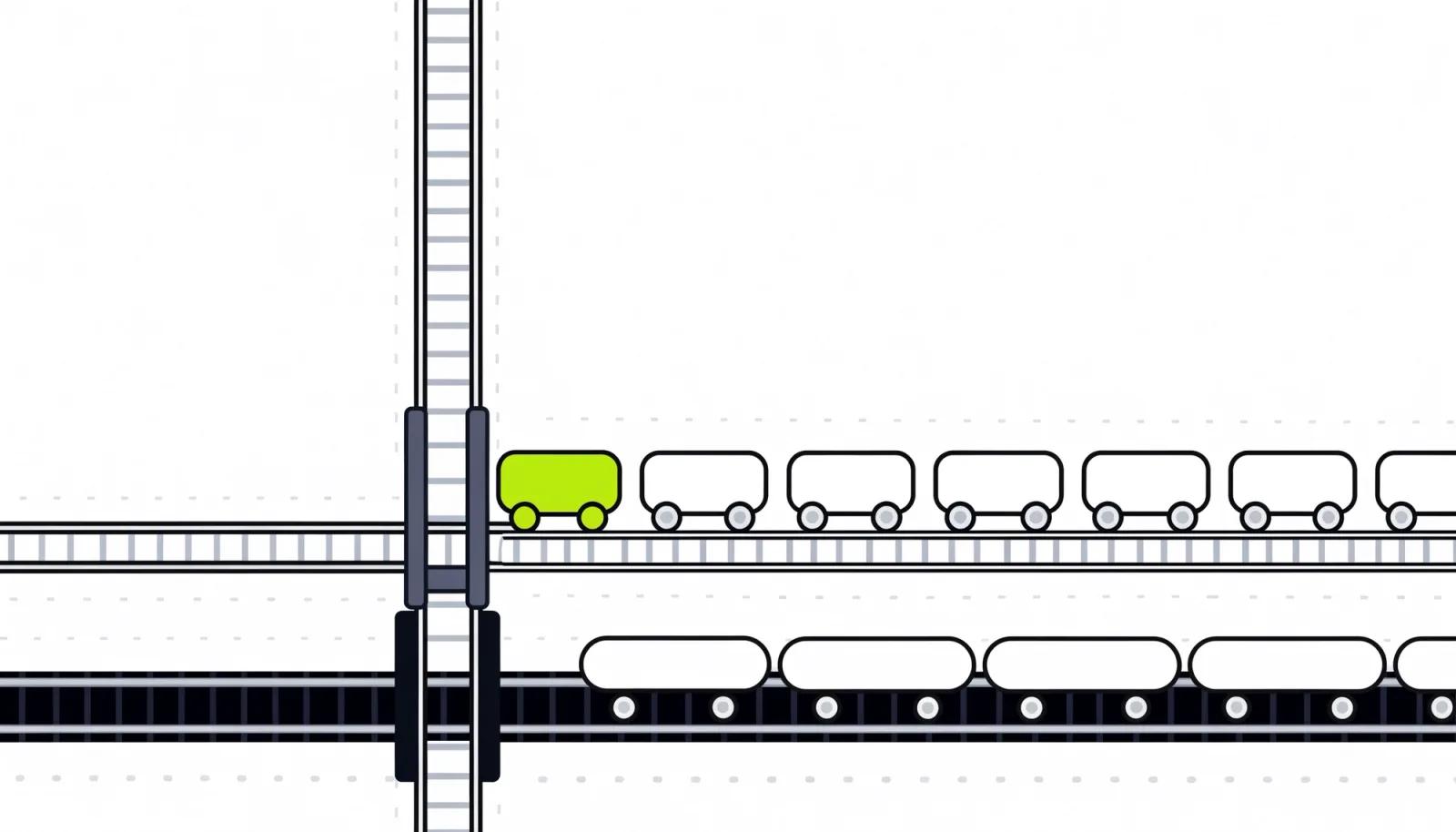
Deal size changes the buying group and the sales cycle
The larger the deal, the more people decide it and the longer it takes, so the selling work per deal rises with the price. The average B2B buying decision involves 13 people.↗ In Gong’s 2025 analysis of 1.8M deals, won large strategic deals had 17 buyer contacts engaged on average.↗ Multi-threading lifted win rates by 130% on deals over $50k.↗ Win rates were 55% higher when a decision-maker was involved early.↗
Small accounts sit at the other end of the range. In telecom, by Panelhop’s estimate, a small ISP decides with 2–4 people and a national carrier with 8–12 or more.↗ The small ISP buys in an estimated 1–6 months, the national operator in an estimated 12–36.↗
The stages hardly change with size. Every deal still moves from the target account list through discovery, evaluation, procurement and close. What changes is how many people each stage must reach, how long it takes and how many AE hours that costs. A team that sells both sizes already runs a small-deal motion and a large-deal motion in the same pipeline, designed or not.
Small and large deals need their own sales motion
We think a small deal and a large deal need different cadence, buying-group coverage and sales involvement. A single AE motion across both fails at each end. In our view, below roughly €50k a single seller can usually run the whole buying group alone. There the risk is a meeting-heavy cycle on a deal that can’t repay the hours. Above it, the buying group grows and the cycle stretches. The risk flips to under-coverage: a single champion and no finance, with security arriving after the price.
An AE who carries both kinds of account splits the week between them. We think the small deals usually win that contest, because they move fast and ask for demos. The large deals get what is left, often a single contact. So the small accounts get more AE time than they can pay for, and the large ones get too little to close.
We don’t think a single ACV cutoff fits every team or every market. Small accounts still need care, delivered through a lighter, faster motion with a named owner. The floor between the motions should come from your own cost of a sale, with fit and dated buying signals deciding the accounts near the line.
Tier accounts by expected deal size and fit
Give each account its sales motion from 2 inputs: the deal it can be worth and how well it fits your ideal customer profile (ICP). Measure both against an AE floor set from your own cost of a sale. It takes 4 steps:
- Estimate the expected deal. Multiply the account’s size driver (subscribers, sites, users or revenue) by your price. Use the size driver rather than the first order: a small first purchase from a large account is still a large account. If you don’t know the size driver, use the nearest public proxy, such as locations, headcount or licences, and mark the estimate unverified until discovery confirms it.
- Set the AE floor. Work out what AE time costs per won deal, then the smallest first-year deal that can carry it.
- Score fit from won and lost deals. Use the traits your closed-won deals share, such as segment, size band, the system they run today and the trigger that opened the deal.
- Assign the motion. Above the floor with strong fit: field sales. Above it with weak fit: an inside rep qualifies first. Below it: low-touch, with the high-fit accounts that have a path to the floor on a watch list.
Here is the arithmetic, as an illustration. An AE costing $150,000 a year over 1,500 selling hours costs $100 an hour.↗ At 40 AE hours per field opportunity and a 25% win rate, each won deal takes 160 hours, or $16,000 of AE time.↗ If you let AE time cost at most half of the first year’s value, a rule to set from your own margin, the floor is $32,000 ($16,000 ÷ 0.5).↗ A $10,000 deal won through field sales costs 1.6× its first-year value in AE time alone.↗ Won through a low-touch tier, at 5 hours per opportunity from a $60-an-hour inside rep, it costs $1,200, or 12%.↗ Put your own hours, costs and win rates from the CRM into the table before you trust the floor.
| Illustrative inputs | Field sales (AE) | Low-touch (inside rep) |
|---|---|---|
| Cost of a selling hour | $100 ($150,000 ÷ 1,500 hours) | $60 ($90,000 ÷ 1,500 hours) |
| Hours per opportunity | 40 | 5 |
| Win rate | 25% | 25% |
| Hours per won deal | 160 (40 ÷ 0.25) | 20 (5 ÷ 0.25) |
| Selling cost per won deal | $16,000 (160 × $100) | $1,200 (20 × $60) |
| Share of a $10,000 first-year deal | 160% | 12% |
| Floor at half of first-year value | $32,000 ($16,000 ÷ 0.5) | $2,400 ($1,200 ÷ 0.5) |
Each tier then gets its own routing rule, cadence and buying-group coverage. Requests and signals from field-sales accounts reach a named AE the same day, and their buying group is mapped before the proposal. Panelhop’s role map starts with 3–5 required roles per tier.↗ Size that tier to your AEs: the working range in our audit is 5–15 one-to-one and 20–60 one-to-few accounts per AE.↗ Low-touch accounts get published pricing, a trial or demo video, a standard contract and an owner by name, never a shared inbox. Many buyers want that path: 67% of B2B buyers in Gartner’s 2025 survey said they prefer a rep-free experience.↗
| Tier | Who goes in it | Owner and routing | Cadence | Buying-group coverage |
|---|---|---|---|---|
| Field sales | Expected deal at or above the AE floor, strong ICP fit | A named AE; requests and signals reach that AE the same day | Two-way contact with the buying group every week, against a mutual plan with dates | Required roles mapped before the proposal: champion, economic buyer, security and procurement |
| Qualify first | Above the floor, weak fit | An inside rep runs a qualification call before an AE invests | A single call, then field sales or low-touch | Champion and economic buyer |
| Low-touch, watch list | Below the floor today, strong fit and a path to the floor | A named inside rep; promotion reviewed monthly | Monthly check-in and alerts on dated buying signals | Champion and economic buyer, often the same person |
| Low-touch | Below the floor, no path to it yet | A named inside rep or customer team | Published price, trial or demo video and a standard contract; renewal reminders | The person who signs |
Which buying signals should move a small account to an AE?
Move a small account to an AE the day a dated event raises its expected deal or adds people to its buying group. Write the promotion rules down, so a promotion doesn’t depend on which inside rep happens to notice. Promote an account when any of these is true:
- Its size driver passes the AE floor: subscribers, sites, users or revenue
- It buys, merges with or is bought by another company
- It wins funding or a contract that adds scope, such as a grant award
- A new CEO, CFO or general manager starts
- Its current system reaches end of support, or its contract nears its end
- Security, legal or procurement joins the conversation
- A second site, business unit or product line asks for a demo
Keep promotions honest with 3 rules:
- Route it the same day. The signal, the re-estimated deal and the people involved reach the AE as a task, with the date the signal fired.
- Accept or return within a week, with a reason. A returned account goes back to the watch list with the reason logged, so the AE book never becomes a dumping ground.
- Demote on evidence, at the quarterly re-tier. A field account whose expected deal fell below the floor, with no two-way contact for 2 quarters, moves to low-touch with a handoff note.
The watch list is how small accounts that could grow stay in sight. Each has a named owner, a monthly review and a short list of the signals that would promote it. When a signal fires, the account reaches an AE that day, with its buying group partly mapped. In field sales the same signals change the plan rather than the owner: a merger or a new CFO adds a role to map and can move the close date.
Baseline AE hours and qualified pipeline per tier first
Measure how AE time and qualified pipeline split across the tiers before you move a single account. In our view, without that baseline almost any after-number can be framed as a win. Pull the last 90 days by tier: AE hours from calendars and CRM activity, qualified opportunities created, win rate, sales cycle and revenue from small accounts. If AEs don’t log time, count meetings and calls per account and agree a fixed hours-per-meeting weight. Use the same rule for the baseline and every month after, so the comparison holds.
| Measure, per tier | Where it comes from | What a working split shows |
|---|---|---|
| AE hours | Calendars and CRM activity, last 90 days | Fewer AE hours on accounts below the floor |
| Qualified pipeline created | Opportunities that pass your qualification stage, count and value | More qualified pipeline per AE hour in field sales |
| Win rate and sales cycle | Closed-won and closed-lost deals by tier | Field deals win as often or more; low-touch deals close faster |
| Revenue and renewals from small accounts | Billing and renewal records for the low-touch tier | Held at the baseline |
| Promotions | Accounts moved to an AE, with the signal and the outcome | Promoted accounts reach qualified pipeline |
A working split shows up in a set order. AE hours on accounts below the floor should fall first, within a month. Qualified pipeline per AE hour in field sales should rise over the next sales cycle. Revenue and renewals from the low-touch tier should hold at the baseline, and promoted accounts should reach qualified pipeline. If small-account revenue drops, the low-touch tier is under-served. If AE hours don’t fall, the routing rule isn’t being followed.
Field sales and a low-touch tier, worked through for telecom
For a telecom software vendor, the split moves small ISPs to a low-touch tier and keeps AEs on operator deals that need a full buying group.
Should AEs sell to small WISPs and ISPs under 2,500 subscribers?
Mostly not. By Panelhop’s estimate, many small ISP and WISP deals fall below €25k a year on published per-subscriber pricing and are decided in 1–6 months.↗ A rural telco or co-operative, by the same estimate, takes 6–24 months through 5–8 people plus the board.↗
In the illustration above, field sales spends $16,000 of AE time to win a $10k deal and the low-touch tier $1,200.↗ Take the top of the band in the question: a $10k deal from an ISP with 2,500 subscribers is $4 per subscriber a year ($10,000 ÷ 2,500).↗ At that price, the illustrative $32,000 floor sits at 8,000 subscribers ($32,000 ÷ $4).↗ In NRTC’s 2024 benchmark of 84 rural broadband providers, the median had 6,100 subscribers.↗ So at least half of them would start in the low-touch tier.↗
The low-touch tier gives the ISP published per-subscriber pricing, a recorded demo, a sandbox, a standard contract and an inside rep who owns it by name. Promote it when it buys a neighbour, signs a BEAD subgrant that adds locations, hires a new general manager or gets an end-of-support notice for its billing platform.↗
Deals that stall at procurement: what to fix first
A 30-person network security vendor whose 12-month UK operator deals stall at procurement has the opposite problem: large deals with too little buying-group coverage. The largest UK operators, in Tier 1 and Tier 2, are expected to apply the supplier measures of the Telecommunications Security Code of Practice to all contracts by 31 March 2027.↗ Their security, legal and procurement teams check each vendor against those measures before terms. By Panelhop’s estimate, supplier assurance alone takes 2–8 weeks.↗ Fix 3 things first:
- Name security, legal and procurement contacts in discovery, before the price.
- Make them and the security evidence request exit criteria before terms.
- Baseline the days each deal spends in review, and report against it monthly.
Should you bring in a fractional CRO who has sold to telcos? We think one can help if nobody on your team knows how operators buy. Make this motion their first job, built into your CRM and written down, so it stays when their contract ends.

In practice
How we do it at Panelhop
Panelhop is an account-based marketing (ABM) and GTM consultancy for B2B companies selling deals of €25k or more. In a Panel Check (GTM audit · 2–3 weeks) we compute win rate and median deal size by size band from your closed-won and closed-lost deals, judge whether your sales motion fits your deal sizes, compare the accounts each AE holds per tier with their capacity and set the baseline before anything changes.
Leak Fix (we build the fixes) then builds the tiers, the routing rules and a role map per tier into your HubSpot or Salesforce, each with a runbook. Signal Desk (in-market accounts, weekly) delivers scored accounts with the dated signal that fired, and Panel Ops (we run it monthly) re-tiers every quarter and reports against the baseline each month. Your reps own every first touch.
Questions buyers ask about this
Should our AEs sell to small WISPs at all?
Usually not through field sales. By Panelhop’s estimate, many small ISP and WISP deals fall below €25k a year on published per-subscriber prices and are decided in 1–6 months, which rarely pays for AE time. Give them a low-touch tier with a named owner, and move a WISP to an AE when it merges, wins funding or grows past your floor.
Should we bring in a fractional CRO who has sold to telcos, and what should they fix first?
We think one can help if nobody on your team knows how operators buy. Make the motion for your operator deals their first job: name security, legal and procurement in discovery, require them before terms and track days in review against a baseline. Ask for it built into your CRM and written down, so it stays when their contract ends.
What ACV cutoff should decide field sales vs inside sales?
No single cutoff fits every team. Work out what AE time costs per won deal from your own hours, cost and win rate, then set the floor where that cost stays within the share of first-year value you accept. Let ideal customer profile (ICP) fit and dated buying signals decide the accounts near the line.
How do we stop small accounts that could grow from getting lost in a low-touch tier?
Give every low-touch account a named owner, and keep the high-fit ones with a path to your floor on a watch list reviewed monthly. Write promotion rules, such as a merger, new funding, a new executive or growth past the floor, that send the account to an AE the same day. Re-tier every account each quarter.
How long before we know whether tiering accounts by deal size worked?
Check AE hours against your baseline first: they should move within a month. Qualified pipeline and win rate per tier need at least a full sales cycle, and small-account revenue shows at renewal. Judge the split on those 3 measures together.