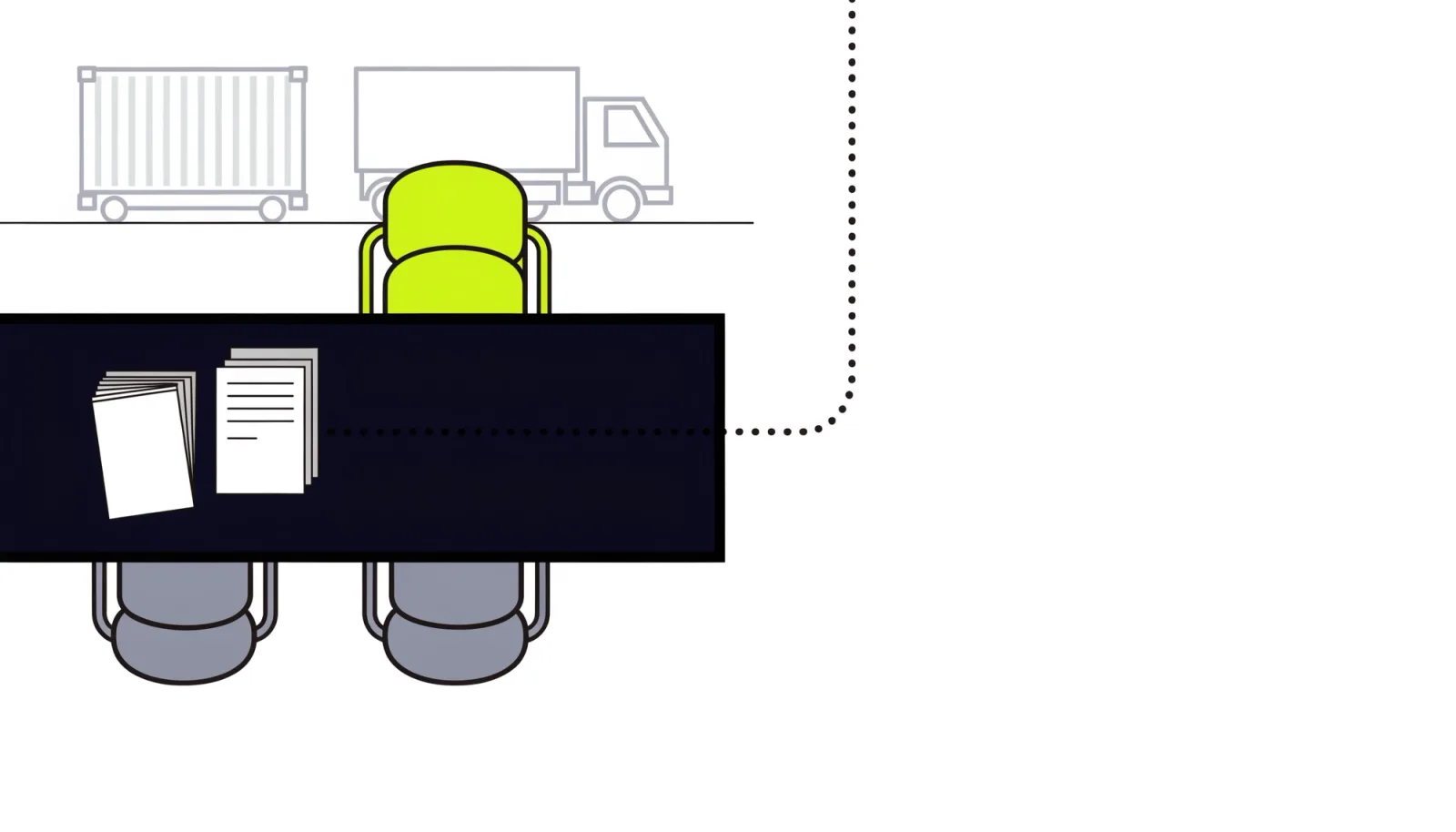
Higher win rates when a decision-maker is involved early in the sales process
Ebsta x Pavilion, 2025Of freight spend: the savings claimed on pages AI answers cite, none backed by a study
Panelhop, 2026Who signs a freight audit deal at a shipper?
The budget owner signs: usually the CFO or VP Finance, and sometimes the VP Logistics when the freight budget sits in logistics.↗ Finance usually holds the pen because the product pays carriers. It changes payment controls and cash timing, and it feeds the freight accruals finance closes each month. The fee needs a budget line, while most of the savings land in freight spend that logistics manages.
That puts the logistics and accounts payable managers who like you in user seats. Logistics feels the overcharges and owns the carrier relationships. AP matches, disputes and pays the invoices. Both gain from your product, and neither can sign for it.
By our estimate, an enterprise shipper’s buying panel for freight audit and payment has 6–13 people, and the sale takes 3–12 months.↗ That is normal for B2B: in Forrester’s 2025 buyer survey, 73% of purchases involved 3 or more departments.↗ Besides logistics, AP and finance, expect the IT and ERP lead for the invoice feeds, information security for carrier bank data and procurement for terms. Procurement professionals are decision-makers in 53% of business buying cycles.↗
A typical deal starts with an audit of a sample of the shipper’s invoices. Then come the business case, the TMS and ERP feeds, a payment-controls review, the contract and carrier onboarding. Mid-market shippers can move within months, while enterprise shippers add a finance-controls and security review.↗
In our research on freight audit vendors, deals stall at 3 points.↗ The sample result stays in AP, finance rejects soft savings at the business case, and payment controls get reviewed last. Ask in the first meeting: “Whose budget pays for this, and who approves a contract this size?”
Logistics and AP alone aren’t a qualified freight audit deal
We think a freight audit deal isn’t qualified until the budget owner, or the person who reports to them, has spoken with you. That holds however warm logistics and AP are. In our experience, 2 fans in user seats mostly mean the case will reach the CFO forwarded, as a deck nobody in finance helped make.
The data shows what waiting costs. Win rates were 55% higher when a decision-maker was involved early in the sales process, across 655,000 opportunities.↗ Multi-threading lifted win rates by 130% on average in deals over $50k, in Gong’s analysis of 1.8M deals.↗
And in a study of more than 2.5M recorded sales conversations, 40–60% of deals were lost to buyers who said they intended to buy but never acted.↗ We think a deal nobody owns is the likeliest to end that way.
So we set a gate. A freight audit opportunity counts as qualified only after the budget owner or their direct report has had a two-way interaction with you.↗ That direct report is usually the controller or the FP&A lead.
Two-way means a call, a meeting or a written reply to a question you asked. A forwarded deck, an opened email or the champion’s word that “finance is positive” doesn’t count. The budget owner or direct report then counts as engaged for 90 days.↗
A deal that fails the gate isn’t lost. It stays at an early stage with one task on it: the finance introduction, with a date.
This is how we apply 2 of our positions. A qualified deal needs engaged people in the seats that matter to the decision. And multi-threading happens reliably only when the plan names who talks to whom, and by when.
Then measure it. Finance-side coverage is the share of open deals past discovery where the budget owner or their direct report had a two-way interaction in the last 90 days.↗ Baseline it first, then report it every week beside the pipeline.
Who do you need on your side, and by when?
Name one person on your side for every seat at the shipper, and a stage by which they have spoken. In practice: your account executive for logistics, AP and procurement, a value lead for the controller, an executive for the CFO, and your solutions engineer and security lead for IT and information security.
Your side of the table matters as much as theirs. Across 10,332 deals, win rates doubled when one more colleague from the seller’s side joined.↗ Deals with 3 or more seller-side people had more than 3× the win rate.↗ Executives were the least used of 4 seller-side roles, yet went with the highest win rates.↗
Win rates rose from 15% with no team selling to 50% with 3 or more seller-side roles involved.↗ Gong’s data shows a correlation; it doesn’t prove that adding people causes the win.
Win rates rose from 15% with no team selling to 50% with 3 or more seller-side roles.
Data behind this chart
| Item | Value |
|---|---|
| No team selling | 15% |
| 3 or more seller-side roles | 50% |
Here is the plan we start from on a freight audit deal. A small vendor can double up, with a founder covering the CFO and the security questionnaire. Each seat still keeps one name and one date.
| Seat at the shipper | What they need to see | Who on your side | By when |
|---|---|---|---|
| VP Logistics or Director of Transportation | Overcharges by lane and carrier, without strained carrier relationships | Account executive | First meeting |
| AP lead | Fewer exceptions, and no payment run that pays a carrier twice | Account executive, then your implementation lead | Before the invoice sample |
| Controller or FP&A lead, the CFO’s direct report | How savings are measured, agreed before the sample and tested on their own invoices | A value lead who can read a P&L | Before the invoice sample |
| CFO or VP Finance, the budget owner | A case their own team built, with payment controls and cash timing covered | Your CEO or your own CFO | Before the business case |
| IT and ERP lead | Invoice and shipment feeds from the TMS and ERP that fit the roadmap | Your solutions engineer | Before the business case |
| Information security | SOC 2 evidence and how carrier bank details are protected | Your security lead | Before payment review |
| Procurement | References, terms and the exit from any incumbent contract | Account executive with your deal desk | Before contract |
In our experience, the seat vendors leave empty is the controller’s counterpart: someone on your side who reads a P&L and talks accruals. Put that person in front of finance before the invoice sample. The champion’s job then changes from carrying your case to making 2 introductions, to the controller and to the CFO.
Give the champion a reason to make them that helps their own case. A line to try: “Before we pull any invoices, could your controller agree with us what counts as a saving? Then the result is finance’s, and you won’t have to defend our numbers.”
Why does finance call your freight audit ROI vendor maths?
Finance distrusts a freight audit ROI when the inputs aren’t its own: a benchmark percentage applied to its spend, findings counted as cash and AP hours counted as savings.
The pages AI answers cite for this question show why a controller is wary. We opened 9 of the 10, and 7 quote savings or error rates as benchmarks or customer results: 1–8% of freight spend, or 18–25% of invoices.↗ None names a study, a sample or a method behind its benchmark, and the 2 customer results each describe one unnamed customer.↗ None of the 9 says who signs.↗
None of those numbers is the shipper’s own, so a controller has no reason to pick one. In our experience they set all of them aside, and your deck with them.
Then come the tests a champion can’t pass alone:
- Are the findings cash, or only flagged?
- Did today’s AP checks already catch some of them?
- Do the AP hours end a cost, or only free up time?
- Is one error counted twice, as a recovery and again as a future saving?
Your champion can’t rebuild the answers on their own carrier invoices, because your model runs on your benchmarks and your tool’s output. When they forward it, the CFO hears a vendor claim from someone who can’t defend it.
How do you build a business case a shipper’s CFO will trust?
Build it with the controller, on the shipper’s own carrier invoices, and agree the measure before the sample runs. Finance then presents a number it made. The order of the steps matters more than the model.
- 01Before the sample
Agree the measure with the controller
Decide together what counts as cash credited by carriers, what counts as cost prevented on future invoices and which AP time ends a real cost.
- 02Proof offer
Pull the shipper’s own invoices
Take 3 months of carrier invoices, with the contracts, rate tables and shipment records behind them. Use a longer window when freight is seasonal.
- 03Proof offer
Classify every finding with finance
Recoverable, prevented or informational. Only what the controller accepts goes into the case, each line tied to an invoice.
- 04Business case
Let the controller build the model
Their spreadsheet and assumptions, your data and method, so they can answer the CFO’s questions without you in the room.
- 05Before commit
Take the case to the CFO together
Your executive and the controller walk the CFO through it. No commit forecast until that two-way meeting has happened.
Start from 3 months of carrier invoices with the contracts, rate tables and shipment records behind them, and use a longer window when freight is seasonal.↗ Classify each finding with finance as recoverable, prevented or informational, and count only what the controller accepts.↗
Hand the controller the line-level findings, each tied to an invoice number, a contract rate and the shipment record. Every number in their model then traces back to a document they can open. Your champion could never do that with your deck.
This is what the method does to a typical deck. Illustrative: the shipper and every number below are fictional, made up to show the method.
A vendor’s deck for a shipper with €40M of freight a year claims €1.2M of savings, from a 2% overcharge benchmark plus AP time and freight data.↗ Rebuilt with the controller on 3 months of the shipper’s invoices, billing errors come to €520k a year, and carriers credit €364k of it.↗ Today’s AP checks already catch €64k of that, leaving €300k, and 2 contractor roles that end add €110k: €410k a year.↗
| Illustrative: a fictional shipper with €40M of freight a year | Vendor deck | Rebuilt with the controller |
|---|---|---|
| Freight billing errors | €800k, from a 2% benchmark | €520k, found in 3 months of the shipper’s invoices and annualised |
| Credited by carriers | Counted in full | €364k, what carriers credit after dispute |
| Already caught by today’s AP checks | Not deducted | €64k deducted, leaving €300k |
| AP time | €250k of hours | €110k from 2 contractor roles that end; the rest shown as capacity |
| Freight data and visibility | €150k | Listed as a benefit only |
| Total a year | €1.2M | €410k |
The rebuilt €410k is smaller, and it is the number the CFO can sign: their own team built it and can defend every line.↗ Set your fee against that number.
Make it a stage rule too. A freight audit deal moves to commit only after the controller has signed off the measure and your executive has met the CFO.↗

In practice
How we do it at Panelhop
A Panel Check (GTM audit · 2–3 weeks) baselines your freight audit pipeline from your own CRM data, stage by stage, including how many contacts are engaged on each open deal and which buying-group roles they cover. Leak Fix (we build the fixes) then makes the budget owner and the controller required roles on the opportunity, adds “finance agreed the measure” as an exit criterion before the invoice sample and builds a weekly finance-side coverage report against that baseline.
Signal Desk (in-market accounts, weekly) brings shippers with a dated trigger, such as an ERP move or a new CFO, scored and with a brief that recommends the invoice-sample play to finance and logistics together. Your rep decides and sends it.
Questions buyers ask about this
Should our champion present the freight audit business case to the CFO?
Not on their own. The champion makes the introductions, the controller presents the numbers finance rebuilt, and your executive answers for the method. A CFO who hears the case second-hand tends to treat it as a vendor claim.
What if the VP Logistics owns the freight budget at this shipper?
Then logistics signs, and finance still decides whether the savings are real and whether the payment controls hold. Keep the controller as a required seat and run the invoice sample with them. The gate stays the same: the budget owner or their direct report has spoken with you.
How many months of carrier invoices should the sample cover?
We start from 3 months of the shipper’s carrier invoices, with the contracts, rate tables and shipment records behind them. Use a longer window when freight is seasonal, so peak surcharges and accessorials show up. Agree the window with the controller before any invoices move.
When does procurement come into a freight audit deal?
Before terms, and earlier if the shipper has to leave an incumbent provider mid-contract. Forrester’s 2026 buyer research found procurement professionals are decision-makers in 53% of business buying cycles. Name the procurement contact when you name the budget owner, so terms don’t start cold.
How do we know whether finance is engaged across our freight audit pipeline?
Track finance-side coverage: the share of open deals past discovery where the budget owner or their direct report had a two-way interaction with you in the last 90 days. Baseline it first, then report it every week. Keep deals without that interaction out of commit.