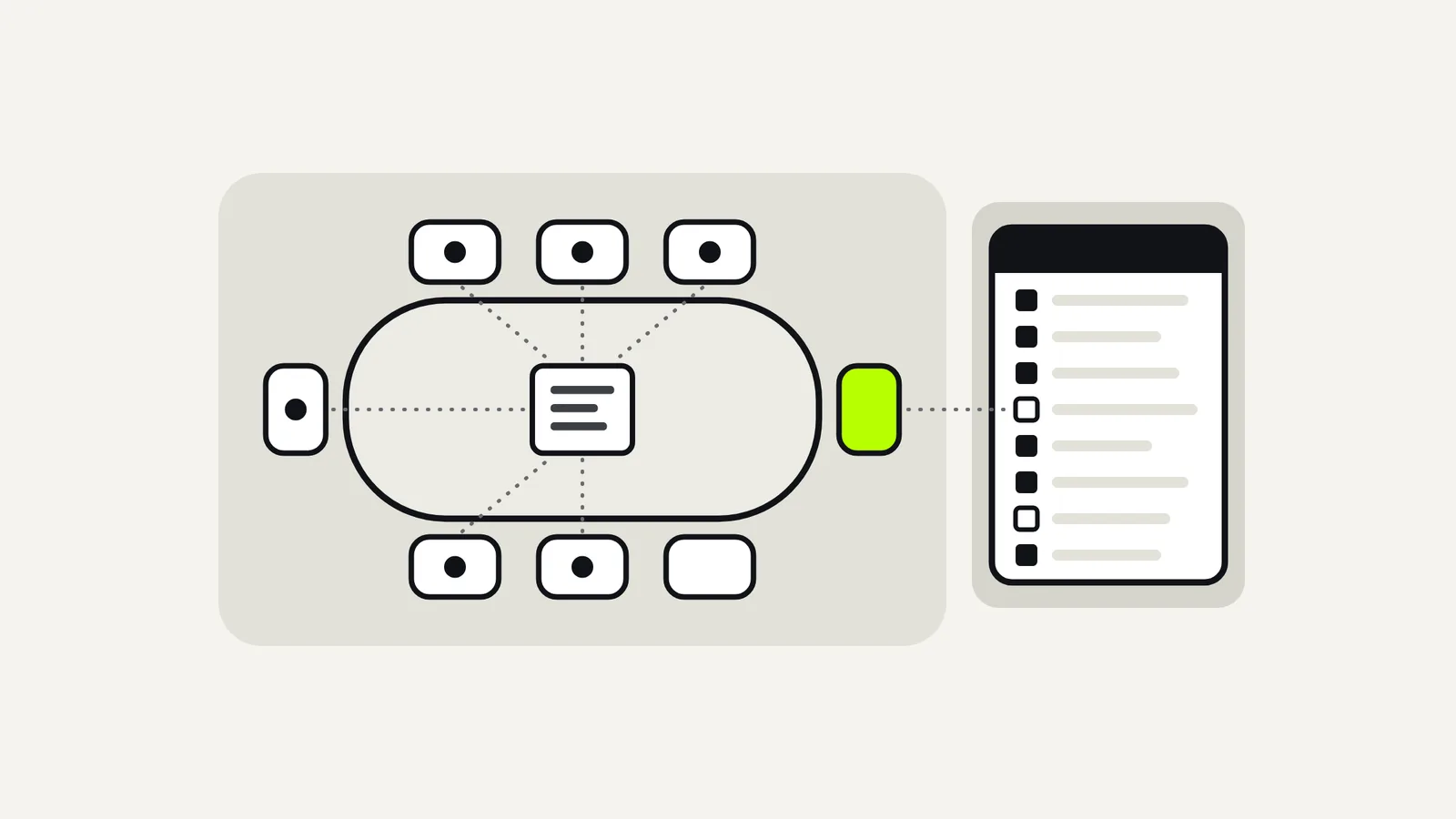
internal stakeholders in the typical B2B buying decision, plus 9 external influencers
Forrester, 2026of US banks under $100bn say a management team or committee approves tech investments
Bank Director, 2026What should an ABM agency actually do for you?
An ABM agency should do 5 jobs, in this order: build a short, well-fit target account list, name the buying group roles that must say yes at each tier, plan who on your team engages each role and by when, run the plays that get those roles talking, and report roles engaged per account against a baseline. Campaigns are the fourth job, so an agency that starts with them is selling reach.
The order follows from the size of the group you sell to. The typical B2B buying decision now includes 13 internal stakeholders and 9 external influencers.↗ Multi-threading boosts win rates by an average of 130% in deals over $50k, in Gong’s analysis of 1.8M deals closed in 2024.↗ That is why account-based marketing (ABM) suits long, multi-stakeholder sales cycles, and why personalised campaigns can’t be the whole job: a campaign can reach a target account without anyone there ever talking to you.
- 01Job 1
A short, well-fit target account list
Tiered to what your sellers can work, with the fit evidence for every account. Ask why each Tier 1 account is on it.
- 02Job 2
The buying group roles at each tier
Required roles per tier, 3–5 of them, taken from your won and lost deals, with the veto roles marked. Ask for named people at every Tier 1 account.
- 03Job 3
An owner and a date for every role
Who on your team engages each role, by when and with what first. Ask for the plan for 3 of your Tier 1 accounts.
- 04Job 4
Plays that get each role talking
Outreach, content, events and peer meetings built around each role’s questions, with ads in support. Ask which play each role is in this week.
- 05Job 5
Roles engaged per account, against a baseline
A monthly report per account with the baseline, the plan and at least one miss. Ask to see the baseline before the work starts.
Ask to see each deliverable for 3 of your own target accounts before you sign. A sample from another client’s market shows that the agency can make a document. Your own accounts show whether it can do the work.
Good ABM help shortens the target account list first
We think the first sign of good outside ABM help is a target account list shorter than the one you started with. Rep attention and the budget for research and signals are both limited. Spread them across more accounts than your team can research and multi-thread, and both thin out. A tighter list also makes account scoring more accurate, because there is less noise to average over.
A short list is what makes the next step possible. We think multi-threading happens reliably only when the plan names who talks to whom and by when. Left to the champion, it is left to chance: reps default to the one contact they’re comfortable with, and the champion has a day job. So we’d judge an agency’s plan by one test: does every required role at every Tier 1 account have a named owner on your side?
We also think the work should be judged by what the buying group did, rather than by what was sent to it. Above about €50k ACV, an MQL target rewards volume the buying group never acted on. A report without a baseline can frame almost any number as a win, so we ask for the baseline before the work starts and for at least one miss in every report. We read a report with no misses as one edited for its reader.
We don’t say every contact deserves equal attention, that multi-threading alone wins a deal, or that one list size suits every team. List size depends on your sellers and your deal size.
Each buying group role needs an owner and a date
Every role that must say yes at a target account needs 3 things in the agency’s plan: an owner on your team, a date to engage it by and a first useful thing to give it. Start from your won and lost deals of the last 4 quarters: who signed, who asked for a review, who stalled the deal. Name 3–5 required roles per tier from that, and mark the ones that can veto. Tier 1 gets the full set. Tier 2 gets the champion, the budget owner and the veto role that most often stalls you. Tier 3 gets none until a buying signal moves the account up.
- Owner. Match peers: your security lead to their security officer, your finance lead to their CFO, a solutions engineer to their IT lead. The champion makes introductions, and the plan doesn’t wait for them.
- Date. Count back from the stage where that role’s yes is needed, by the length of its review. A security review starts as far ahead of the business case as it takes, instead of after the verbal yes.
- First useful thing. What that role needs to judge you: the integration path for IT, the security file for security, the cost model for finance. A pitch deck isn’t one.
Early involvement pays. When decision makers were actively involved in the first 2 stages of the sales process, win rates rose by 55% across 655,000 opportunities in Ebsta and Pavilion’s 2025 benchmark.↗ Ask the agency for this plan for each Tier 1 account before any campaign goes live. A stakeholder list says who is in the room. The plan says who will talk to each of them, and when.
When does a buying group role count as engaged?
A role counts as engaged when someone in it has had a two-way exchange with your team in the last 90 days: a reply to a question you asked, a call, a meeting they attended or a written answer in their own review. Everything one-way stays out of the count: impressions, opens, clicks, website visits, webinar sign-ups, intent data surges, MQLs and the champion’s account of a meeting. An ad served to a CFO says nothing about whether that CFO will back the deal, and fewer than 1% of leads convert to closed deals.↗
Keep the number honest with 3 counting rules:
- Count each role once per account. However many people in one department engage, they count once.
- Report per account, never per contact. A long list of engaged contacts can hide target accounts where nobody who can veto has spoken to you.
- Count a role where it sits. If the CFO who signs sits at the parent company, count that CFO there.
Then tie qualification to the count. An account counts as engaged when 3 or more of its required roles are engaged and the budget owner is one of them. Only then does an opportunity there count as qualified. A single enthusiastic contact opens a door into the account; it doesn’t make a qualified opportunity.
How do you judge ABM work against a baseline?
Take a baseline of required roles engaged per target account before the agency starts, count the same way every month, and ask for at least one miss with its cause and its fix. The table shows the arithmetic for a fictional team, as an illustration: 40 target accounts, 10 in Tier 1 with 5 required roles each and 30 in Tier 2 with 3 each, so 50 + 90 = 140 required roles. The baseline is the quarter before the agency started. The numbers are made up to show the method; none of them is measured.
| Measure (illustration: a fictional team) | Baseline | Day 90 | Plan for day 90 |
|---|---|---|---|
| Tier 1 required roles engaged (of 50) | 6 (12%) | 21 (42%) | 20 |
| Tier 2 required roles engaged (of 90) | 8 (9%) | 17 (19%) | 15 |
| All required roles engaged (of 140) | 14 (10%) | 38 (27%) | 35 |
| Target accounts with 3+ required roles engaged, the budget owner among them | 1 | 5 | 4 |
| Tier 1 accounts with no required role engaged | 4 | 1 | 1 or fewer |
| Qualified opportunities opened in target accounts | 1 | 3 | 2 |
| Miss: Tier 1 accounts with security or vendor risk engaged (of 10) | 1 | 2 | 6 |
Read it from the top. Required roles engaged rose from 14 of 140 (10%) to 38 (27%), and target accounts with 3 or more required roles engaged, the budget owner among them, rose from 1 to 5. The miss matters most: security or vendor risk engaged at 2 of 10 Tier 1 accounts, against a plan of 6. Its cause (the security file wasn’t ready, so security had nothing to answer) and its fix (send the file before asking for the meeting) show an agency managing the work, rather than reporting on it.
At 90 days, judge the leading measures: roles named, roles engaged, accounts engaged and opportunities opened. Win rate needs far more closed deals than one quarter produces at these deal sizes. Agree the definitions and the day-90 plan in writing before the work starts, then watch for 4 warning signs in a monthly report:
- reach or impressions presented as engagement
- contacts counted instead of roles
- no baseline, or a definition that changed halfway through
- no misses at all
Engage the CIO, ISO and VMO before the business case
At a community bank, give the CIO, the information security officer (ISO) and the vendor management officer (VMO) each an owner on your side and a date before the business case, and send each the file they need to judge you. Selling software to banks runs on the same plan, with several roles that can say no. By Panelhop’s estimate, 5–12 people decide on software at US community banks, credit unions and DACH banks, and in Panelhop’s model of the buying group at a mid-size bank or credit union, 6 of 8 roles can veto.↗ Approval sits with groups: at US banks below $100bn in assets, 65% say a management team or steering committee has final approval of technology investments, and 11% say the IT department drives them.↗
At most US banks below $100bn, a team or committee gives final approval of technology investments; few leave them to IT.
Data behind this chart
| Item | Value |
|---|---|
| A management team or steering committee has final approval | 65% |
| A C-level executive other than the CIO or CTO has final approval | 40% |
| The board is directly involved in major technology decisions | 30% |
| IT and business line leaders decide jointly | 28% |
| The IT department drives investments | 11% |
| Decided ad hoc within business lines or functions | 7% |
Vendor management’s file grows with your risk. Proposed interagency guidance from the OCC, the Federal Reserve, the FDIC and the NCUA says the amount of due diligence warranted depends on the risk the third-party relationship presents, and it covers insured credit unions too.↗ The VMO’s early read of your risk tier therefore sets how much due diligence you will face, so build the business case after it.
The plan below is an illustration: a fictional fintech selling a €60k-a-year add-on to a fictional community bank, inside the €25–150k a year that Panelhop estimates for add-on software at US community banks under $1bn.↗
| Role (illustration) | Owner on your side | Engage by | First useful thing | Counts as engaged when |
|---|---|---|---|---|
| Business owner, your champion | Account executive | Week 0, discovery | The problem in the bank’s own numbers | Agrees the problem and books the next meeting |
| CIO or IT lead | Solutions engineer | Week 2 | The integration path on the bank’s own core, and access to its data | Answers your integration questions or meets you |
| Information security officer (ISO) | Your security lead | Week 3, at the fit check | A current SOC 2 Type II report, penetration test results and the subprocessor list | Sends questions on the file or reviews it with you |
| Vendor management officer (VMO) | Your compliance lead | Week 3, at the fit check | A due diligence file, a proposed risk tier, an exit plan and draft contract terms | Confirms the risk tier and what due diligence will need |
| Compliance officer | Your compliance lead | Week 4 | How the product meets the bank’s regulatory duties, with its audit trail | Answers in writing or meets you |
| CFO | Account executive with your finance lead | Week 5 | The business case, built on the answers from IT and vendor management | Reviews the numbers and the cost model |
| Board or technology committee | Through the CEO and the CFO | Meeting date on the close plan by week 5 | A one-page summary of fit, risk and cost in plain language | Its meeting date is confirmed |
To bring them in without going around your champion, ask the champion for one 30-minute fit check with the CIO, the ISO and the VMO before the business case. Frame it as saving the bank time: if the review would fail, everyone learns it in week 3 instead of in due diligence. Count each of them as engaged only once they’ve replied, met you or answered in writing.

In practice
How we do it at Panelhop
Panelhop is an account-based marketing (ABM) and GTM consultancy for B2B companies selling deals of €25k or more. We work in your own CRM, and we don’t send volume cold email: your reps own the first touch. For teams selling software to banks and credit unions, we start from our banking research: the roles that decide, the ones that can veto and the buying signals that open a deal.
The Panel Check, our GTM audit of 2–3 weeks, scores targeting, engagement plays and qualification from your CRM records, drafts your ICP and tiers from closed-won and closed-lost deals, and records the baseline every later number is reported against. Signal Desk then sends in-market target accounts each week, each with a buying-group map of the roles needed, found and verified and a research brief drafted by AI and reviewed by us. Where the buying group is the leak, Leak Fix, where we build the fixes, has a buying-group coverage module that maps the roles per tier, finds the missing ones and tracks coverage per account and deal. Panel Ops, which we run monthly with your team, then reports accounts by stage against the baseline.
Questions buyers ask about this
What should an account-based marketing agency for fintech companies selling to banks actually do?
The same 5 jobs as for any high-ACV seller, with the bank’s buying group built in: a short list of banks that fit, the roles that decide at each tier (business owner, CIO, information security, vendor management, compliance, CFO and the board or a committee), an owner and a date for each role, and a due diligence file ready before the business case. Judge it by roles engaged per bank against a baseline, and ask to see its plan for 3 of your own target banks before you sign.
How do you sell software to banks?
Pick banks whose core platform, size and timing fit, and watch for buying signals such as a core contract entering its renewal window, a merger, an enforcement action or a new CIO or CISO. Then plan the whole buying group: at most US banks under $100bn a team or committee gives final approval of technology investments, and in Panelhop’s model IT, information security, vendor management and compliance can each veto. Engage those roles before the business case, and put the board or committee date on your close plan.
How do we get the CIO, ISO and vendor management officer at a community bank into the conversation before the business case?
Ask your champion for one 30-minute fit check with all 3 before the business case, framed as saving the bank time if the review would fail. Bring a solutions engineer with the integration path for the bank’s own core, your security lead with a current SOC 2 Type II report, penetration test results and the subprocessor list, and a due diligence file with a proposed risk tier and exit plan for the vendor management officer, so the risk team meets you long before due diligence.
How many buying group roles should be engaged before a target account counts as qualified?
Set 3–5 required roles per tier from your won and lost deals, and mark the ones that can veto. Count the account as engaged when 3 or more of them have had a two-way exchange with your team in the last 90 days and the budget owner is one of them; only then call its opportunity qualified.
How soon should an ABM agency show results?
In the first month you should see the target account list, the roles per tier and the engagement plan for your Tier 1 accounts. By day 90, roles engaged per account should be up against the baseline, with every miss explained. Win rate and revenue take longer at €25k+ deal sizes, because one quarter closes too few deals to read them.