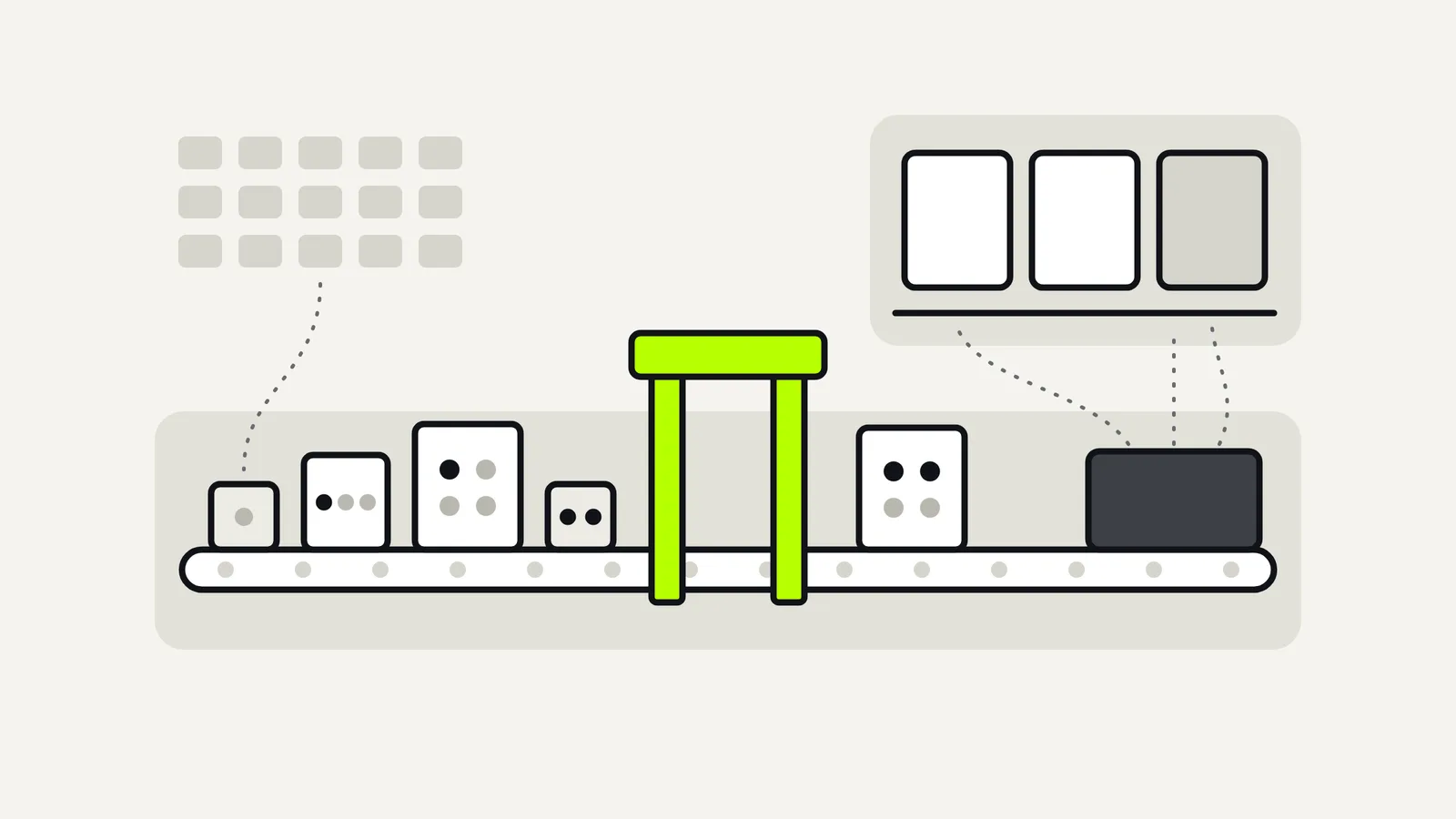
internal stakeholders in a typical B2B buying decision, plus 9 external influencers
Forrester, 2026higher win rates when decision makers are actively involved in the first 2 sales stages
Ebsta x Pavilion, 2025Who owns account scoring, buying group mapping and first touches?
A named new-logo lead does, backed by marketing and RevOps. The account executives (AEs) who hold your key accounts stay out of it. That lead owns every step up to a qualified opportunity, and the AE owns the deal from there to the signature. AE hours are the scarcest input, so they go only to the part of a deal where an AE changes the outcome.
The stages themselves stay the same: prospecting, qualification, a first meeting, proposal, negotiation and contract. Guides to SMB, mid-market and enterprise selling explain how AE roles differ by deal size, cycle and buying group. They don’t say who does the early work while your best AEs keep the accounts that carry the revenue.
| Step | Owner | AE time | Done when |
|---|---|---|---|
| ICP and target account list | RevOps and marketing, from won and lost deals | A review of Tier 1 once a quarter | Named accounts in the CRM, each with a fit score |
| Account scoring and tiers | RevOps | None | Expected deal size and a tier on every account |
| Buying group mapping | New-logo lead, with research support | None | The roles each tier needs, named for each account |
| Buying signals | RevOps or a signal service, routed to the new-logo lead | None | Each dated signal reaches the lead the same day |
| First touches | New-logo lead; a founder or an executive where a Tier 1 buyer expects a peer | None | Two-way contact with the first roles |
| First meeting | New-logo lead | None | Meeting held and the pain written in the buyer’s words |
| Qualified opportunity to contract | AE, inside the tier’s AE hours | The tier’s hours | Contract signed |
The new-logo lead is the one role this needs. It can be a founder, a senior marketer or a seller moved off renewals. Either way, one person owns the list end to end. Their target is qualified opportunities handed over; meetings booked are only activity. Mapping takes most of their time, because a typical B2B buying decision now involves 13 internal stakeholders and 9 external influencers.↗
First touches come from the lead, or from a founder or executive where a Tier 1 buyer expects a peer. Buying signals reach the lead the same day, with the reason attached. They come from intent data or from dated events such as a new CFO or a funded build. The AEs’ only part before the qualified opportunity is a quarterly review of the Tier 1 list. They know why the big accounts bought, and that is a strong check on the ideal customer profile (ICP).
When should the AE take over a new-logo opportunity?
At a qualified opportunity, and only when 4 things are on the record:
- A meeting held. It took place, with the buyer’s people in it. A booked meeting that slips doesn’t count.
- Pain confirmed. The buyer named the problem and what it costs or when it must be fixed, in their own words. The new-logo lead wrote it on the opportunity.
- At least 2 roles engaged. Each of 2 different roles in the buying group has had a two-way exchange with your side in the last 90 days. That means a reply to a question you asked, a call or a meeting. Opens and clicks don’t count, and 10 people from IT are still 1 role.
- Budget reach. One of the 2 is the budget owner or reports directly to them.
The last 2 conditions carry the evidence. Multi-threading lifts win rates by 130% on average in deals over $50k.↗ Across 655,000 opportunities, win rates rose by 55% when decision makers were actively involved in the first 2 stages of the sales process.↗ The gate brings both forward to the day the AE joins. No AE spends a first hour on a deal with a single thread and no route to the money.
Write the gate into the CRM as 4 required fields on the opportunity. They are the meeting date, the pain in the buyer’s words, the engaged roles and whether the budget owner is one of them. The stage can’t move until all 4 are filled. With them comes a short handover note for the AE. It gives the tier and expected deal, what each engaged role said, the route to the budget and the agreed next step.
The AE accepts or returns each opportunity inside an agreed window, for example 5 working days. A return names what is missing and goes back to the new-logo lead. If a Tier 1 buyer will only meet an executive, the AE can join that first meeting. The hour counts against the tier’s AE hours. Read the return reasons once a month, and if most say the budget owner is missing, coach that step and keep the gate where it is.
Deal size sets the AE hours each new-logo tier gets
Give new logos only the AE hours your key-account plan leaves, then share them out by deal size. A bigger expected deal gets more AE hours per open opportunity. Here is the arithmetic for a fictional vendor with 4 AEs whose 3 largest customers carry most of its revenue. It is an illustration, so replace every input with your own.
- Selling hours: 4 AEs × 30 hours a week × 12 weeks = 1,440 hours a quarter.↗
- Key accounts first: renewals, expansion and remapping the customer that froze spending take 1,224 hours (85%), which leaves 216 for new logos.↗
- Hours per open opportunity: 30 a quarter at Tier 1, 15 at Tier 2 and 5 at Tier 3.↗ At Tier 3 the new-logo lead runs the deal and the AE only prices and signs off the proposal.
| Tier (illustration) | Expected deal a year | AE hours per open opportunity a quarter | Open opportunities | AE hours a quarter |
|---|---|---|---|---|
| Tier 1 · 1:1 | €250k or more | 30 | 3 | 90 |
| Tier 2 · 1:few | €75–250k | 15 | 6 | 90 |
| Tier 3 · 1:many | €25–75k | 5 | 7 | 35 |
| Low-touch | Under €25k | 0 | Inside rep’s list | 0 |
| Total | 16 | 215 of 216 |
So the AEs can carry 3 Tier 1, 6 Tier 2 and 7 Tier 3 opportunities at once, 16 in all, inside 215 of the 216 hours.↗ That number sizes everything upstream. The new-logo team’s job is to keep those places full of qualified opportunities; extra meetings booked don’t fill them. When the places are full, the next qualified opportunity waits or becomes the case for hiring a new-logo AE. It is never a reason to borrow key-account hours.
The tiers follow the 3 account-based marketing (ABM) motions. Tier 1 is 1:1 at €250k or more a year, Tier 2 is 1:few at €75–250k and Tier 3 is 1:many at €25–75k.↗ Below €25k, a named inside rep or a partner runs the account from first touch to contract. Set the hours per open opportunity from your own data. Take AE calendar and CRM time on last year’s won deals in each tier and divide by the quarters each stayed open.
Before the split starts, record a baseline. Measure AE hours on new logos, qualified opportunities created per quarter by tier and the health of the key accounts. Then check AE hours against the cap every week. If new-logo hours creep up, key-account time is what pays for it.
Tier accounts by subscriber count, funding and billing system
Turn subscriber count into an expected first-year deal and tier on that. Then let funding status set the timing and the billing system set the fit and the trigger. The tier picks the owner. Here is the method for a fictional network software vendor whose 3 national operators bring in 60% of its revenue.↗ After its merger, one of the 3 froze capex.
A freeze like that fits the year: Dell’Oro Group projects worldwide telecom capex to decline 2% in 2026.↗ The vendor’s 4 AEs stay on the 3 operators. There, by Panelhop’s estimate, core system selections run 12–36 months with 8–12 or more people deciding.↗ The AE on the frozen account remaps its buying group, since a merger can move the budget.
The new-logo lead works regional carriers, cable MSOs and MVNOs, where cycles are shorter. By Panelhop’s estimate, they run 9–18 months at mid-size rural telcos and altnets, where 5–8 people plus the board decide.↗ At small US ISPs and WISPs and at MVNOs, the estimate is 1–6 months.↗
Sales cycles run up to 6 months at small ISPs and MVNOs and up to 36 at national operators
Data behind this chart
| Item | Value |
|---|---|
| Small US ISPs, WISPs and MVNOs | 6 months |
| Mid-size rural telcos and altnets | 18 months |
| National operators and MNOs | 36 months |
The tiering sheet below prices each fictional account at an illustrative €4 per subscriber a year and uses the tier bands above.↗
| Account (fictional) | Subscribers × €4 a year | Funding status | Billing system | Tier and owner |
|---|---|---|---|---|
| Rural WISP | 500 → €2k | None | Spreadsheet and a payments app | Low-touch: a named inside rep, never an AE |
| Cable MSO | 18,000 → €72k | None | Competitor’s, term ends in 14 months | Tier 3, work now: the new-logo lead closes, the AE signs off |
| Regional telco | 30,000 → €120k | BEAD subgrant signed | End of support announced | Tier 2, work now: new-logo lead to the qualified opportunity, then an AE |
| MVNO | 60,000 → €240k | Not applicable | Competitor’s, renewed last year | Tier 2, watch: buying signals only until a dated trigger |
| Regional carrier | 90,000 → €360k | Funded build | In-house, no end date | Tier 1, work now: new-logo lead and an executive to the qualified opportunity, then an AE |
Funding and the billing system set the timing. By Panelhop’s estimate, a signed BEAD subgrant gives 1–6 months to act and an end-of-support notice gives 6–18 months to switch.↗ A competitor’s contract is best worked 12–18 months before its term ends, also by Panelhop’s estimate.↗ An account with one of those dates is worked now. One without stays on its tier’s watch list until a buying signal arrives.
So the 500-subscriber WISP never reaches an AE: at €2k a year it belongs to a named inside rep.↗ The 30,000-subscriber telco is a €120k deal with a signed subgrant and a billing system going out of support.↗ It goes to the new-logo lead now and to an AE at the qualified opportunity. That closes a leak Panelhop’s research describes. Where accounts aren’t tiered by subscriber count, a deal below €25k a year gets the same field-sales effort as a rural telco deal, which by Panelhop’s estimate runs €50–250k.↗ By Panelhop’s estimate, many small WISP and ISP deals fall below €25k a year on published per-subscriber pricing, which rarely pays for AE time.↗
Revenue concentration needs a short target account list, not volume
We think a burst of outbound volume is the wrong answer to a frozen key account. The pressure to replace revenue fast pushes teams to buy meetings. At these deal sizes, those meetings land on the AEs who are meant to be protecting the accounts you can’t lose. The constraint is AE hours and access to the buying group, and more cold email adds neither. Outbound as such is fine: a reviewed first touch from a named person to a mapped role is outbound too.
We think a short, well-fit list beats a long, loose one here, for 3 reasons. Seller attention is the scarce input, so every marginal account takes research and mapping away from the good ones. A single engaged contact isn’t a qualified opportunity. So a list sized to what the team can multi-thread gives the AEs more deals they can take than a list sized to a sending tool. And deal size decides the design. A small WISP and a large regional carrier need different motions; one AE list for both wastes hours on the first and starves the second.
We don’t give a right list size, because it depends on the team and the deal size. Work it back from the AE hours above and from how many accounts the new-logo lead can keep at 2 or more engaged roles.

In practice
How we do it at Panelhop
Panelhop is an account-based marketing (ABM) and GTM consultancy for B2B companies selling deals of €25k or more. We start with a Panel Check (GTM audit · 2–3 weeks): 32 checks across 8 areas, scored from your CRM data. Among them: whether your tiers match what your team can work, how many buying group roles are engaged per target account and whether “qualified” is written down and agreed. It sets the baseline before anything changes.
Signal Desk (in-market accounts, weekly) then does the work before the AE. Each week it sends scored and tiered accounts with a buying group map of the roles needed and found. Each account comes with a research brief drafted by AI and reviewed by a person, and your new-logo owner makes the first touch. Leak Fix (we build the fixes) writes the tiers, the qualified-opportunity gate and the routing into your HubSpot or Salesforce. Panel Ops (we run it monthly) re-tiers each quarter and reports against the baseline.
Questions buyers ask about this
Should we hire SDRs or a new-logo AE while our AEs protect key accounts?
Hire for the step that is short of hands. If your AEs’ spare hours are already full of qualified opportunities, hire a new-logo AE. If the gap is research, buying group mapping and first touches, we think one new-logo lead with marketing support does more at €25k+ than an SDR team paid on meetings booked.
What counts as an engaged role in the buying group?
A role is engaged when someone in it has had a two-way exchange with your side in the last 90 days: a reply to a question you asked, a call or a meeting. Opens, clicks and connection requests don’t count, and 10 people from IT are still 1 role.
How many target accounts should the new-logo list have?
As many as the new-logo lead can research, map and keep engaged, and enough to keep the AEs’ new-logo hours full. In the illustration above that means 16 open opportunities at once; work back from that number and your own rate of engaged accounts becoming qualified opportunities.
What should we do about the key account that froze spending?
Keep its AE on it and treat the freeze as a change in the buying group: find out who owns the budget now, when the freeze will be reviewed and which projects survive it. After a merger, check whether spending decisions moved to the acquirer, and map the combined buying group before the freeze lifts.
How do we tier ISP accounts by subscriber count, funding status and billing system so a 500-sub WISP never lands with the same AE as a 30,000-sub telco?
Multiply subscribers by your price per subscriber to get the expected first-year deal and set the tier from that. Funding status and the billing system’s end-of-support or contract dates then decide whether an account is worked now or watched. At an illustrative €4 per subscriber a year, the WISP is a €2k deal for a named inside rep and the telco a €120k Tier 2 deal that reaches an AE at the qualified opportunity, because routing reads the tier.