Pilot purgatory? Sell the rollout to its own buying group
A rollout is a new decision with a new buying group. Open it as its own deal before the pilot ends, with a group budget owner, finance and each site’s lead.
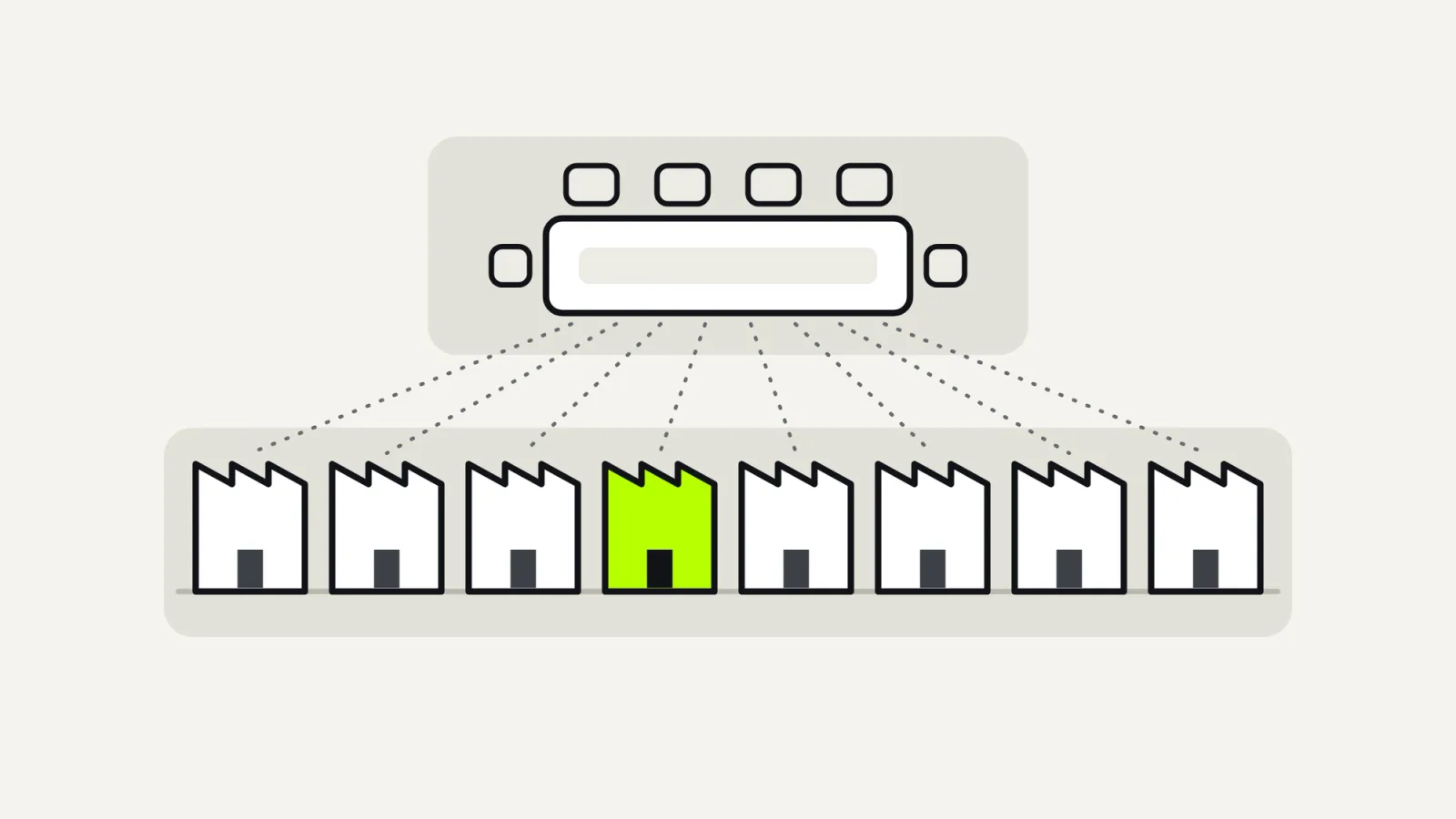
of manufacturers have deployed MES enterprise-wide, though 93% have it in place
Rockwell Automation, 2026vendors selling into manufacturing where plant-by-plant expansion is a likely bottleneck
Panelhop, 2026higher win rates when decision makers are involved in the first 2 sales stages
Ebsta x Pavilion, 2025Why does nobody own the rollout budget after a pilot?
Nobody owns it because the rollout is a second decision, made by a different buying group from a budget the pilot never touched. The pilot answered a single site’s question: does this work here? That site paid for it, or the vendor did. The rollout asks the group’s questions: should this become the standard everywhere, who pays for the other sites and who supports it? The people who answer those were rarely part of the pilot, so its success gives them no reason to act.
Manufacturing has the clearest numbers. Rockwell Automation’s July 2026 report drew on 1,560 operations decision makers.↗ It found a manufacturing execution system (MES) in place at 93% of manufacturers, but deployed enterprise-wide at only 28%.↗ Panelhop’s analysis of 20 vendors selling into manufacturing found plant-by-plant expansion a likely pipeline bottleneck for 10 of them and pilot purgatory for 5.↗ None of the 20 publishes a pilot charter, scale-up KPIs or multi-site pricing.↗
93% of manufacturers have MES in place, but only 28% have deployed it enterprise-wide
Data behind this chart
| Item | Value |
|---|---|
| MES in place | 93% |
| Deployed enterprise-wide | 28% |
| Fully integrated with ERP, PLM, quality and OT | 23% |
The same split appears wherever a customer runs many sites: hospitals in a health system, warehouses in a network, branches of a bank. A site’s manager can buy for that site. Nobody there can commit the others.
Most writing on pilot purgatory speaks to the buyer about governance, ownership and data foundations. A seller can’t wait for the buyer to fix those. So run the rollout as a sale of its own, with its own buying group, opportunity and dates.
Who is in the buying group for a multi-site rollout?
The rollout’s buying group has 2 layers: a group layer that funds and standardises the rollout, and a site layer at each site that has to accept the change. A pilot reaches the site layer of a single site, often through 1 or 2 people.
The group layer has 4 roles. The budget owner is the executive who answers for the pilot’s measure across every site: a COO, a head of operations or a business unit head. Group finance runs the budget round and agrees how a site’s result becomes money. The standards owner, in IT, OT or security, decides whether the system becomes the standard. Procurement sets the frame agreement, the multi-site price and the contract route.
The site layer has 2 or 3 roles at each site. The operations lead, such as a plant manager or site director, decides whether the site takes the change on, and when. Site finance holds the site’s budget line. In German sites with a works council, software able to monitor staff behaviour or performance needs the council’s agreement before it is introduced, pilots included.↗
| Role | Layer | What it decides | Engage by |
|---|---|---|---|
| Budget owner: a COO, head of operations or business unit head | Group | Whether the rollout gets a budget line, and when | Named before kick-off, met in week 1 |
| Group finance | Group | How a site’s result becomes money, and the capex or opex route | By mid-pilot |
| Standards owner in IT, OT or security | Group | Whether the system becomes the standard | Week 1, so the review runs alongside the pilot |
| Procurement | Group | The frame agreement, multi-site price and contract route | Before the readout |
| Operations lead at each next site | Site | Whether the site takes the change on, and when | Before the readout, at the pilot line |
| Site finance | Site | The site’s budget line or capital request | Before the site’s budget round |
| Works council, at German sites that have one | Site | Whether software that can monitor staff may be introduced | During the pilot |
Expect a bigger group than the pilot had. By Panelhop’s estimate, buying groups at multi-site manufacturers, from pilot plant to group, have 8–15 people.↗ In Panelhop’s model of that group, 6 of 8 seats can veto.↗ Across B2B purchases in general, Forrester found 73% involve 3 or more departments.↗ Count roles: 10 people from a single IT team still fill 1 role.
Find the rollout budget owner, then plan each contact
Find the executive whose scorecard carries the pilot’s measure across every site. Then give each role in the rollout’s buying group a named contact, an owner on your side and a date before the pilot ends. Start with 4 questions:
- Who does the pilot site’s lead report to on the measure the pilot moved?
- Who funded the last system that went from a single site to every site?
- Who approves spend above a site’s limit, and when does the budget round close? Ask the site’s controller.
- Who heads operations, or the function your product serves, in the annual report or the group’s announcements?
If nobody owns the measure across sites, that is your first finding. Propose an owner, the executive who gains most when the measure moves everywhere, and ask your champion for 1 introduction.
Then write the sequence into the pilot plan. Here it is for a 4-week pilot; for a longer one, stretch the weeks and keep the order.
- 01Account executive and pilot site lead
Name the group sponsor
Put the scale-up criteria and the multi-site price in the pilot charter, and open the rollout opportunity.
Before kick-off - 02Your executive and the group budget owner
Agree what the pilot must prove
The measure in the group’s terms, and the decision date in the budget round.
Week 1 - 03Your technical lead and IT, OT and security
Open the standards review
Send the architecture and security documents, so the review runs alongside the pilot.
Week 1 - 04Your value lead and group finance
Agree how results become money
The value per site, the capex or opex route and who approves which amount.
Week 2 - 05Pilot site lead and the next 2 sites’ operations leads
Show the pilot line
Each visiting lead names a start window and a budget line. Your account executive confirms the contract route with procurement.
Weeks 3–4 - 06Pilot site lead, presenting to the group budget owner
Ask for the decision
The results in the group’s measure, with the multi-site price, the site sequence and the decision date.
Readout
If the pilot has already ended, run the same sequence from today, with a new readout to the budget owner as the last step. Match each role with someone on your side who can answer its first question. Send an executive to the budget owner, someone who reads a P&L to finance and an engineer to IT and OT. If a date passes without a two-way exchange, the role gets a new date and a reason at the next review.
Open the rollout as its own opportunity in the CRM
Open a separate rollout opportunity on the customer’s parent account in the week the pilot is chartered, with its own roles, stages and close date. Link it to the pilot deal and to each site account it covers. Its value is the multi-site price for the sites in the plan. Its close date is the group’s decision date in the budget round.
Make the handoff from pilot to rollout a stage with entry criteria. The rollout enters “Rollout qualified” only when every item below is true, and it counts as pipeline from that day.
- The group budget owner is named and engaged: a two-way exchange in the last 90 days
- Group finance has agreed how the pilot’s result becomes money at each site
- The scale-up criteria and the multi-site price are agreed in writing
- The site sequence is set, and the operations leads at the next 2 sites are engaged
- The decision date sits in the group’s budget or capital calendar
- Every required role has an owner on your side and an engage-by date
Track coverage on both layers. Coverage is engaged roles divided by required roles, counted for the group layer and for each site in the sequence; engaged means a two-way exchange in the last 90 days.↗ A rollout with every group role engaged and no site leads has money and no users. The reverse has users and no money.
Forecast the 2 deals apart. If the first site’s order is still open, it closes at the first site’s value only. The rollout moves to best case when the group’s budget or capital request is filed with an approval date, and to commit when the approval is in writing. Every move of its close date carries a reason.
In HubSpot or Salesforce, that means a parent account, a child account for each site that can buy or block, a role on every contact and the rollout opportunity linked to its site accounts.
A champion at the pilot site is not a qualified rollout
We think a champion at the pilot site is 1 engaged person, not a qualified rollout. We’d keep the rollout out of pipeline until the group budget owner, group finance and the next sites’ operations leads are engaged, for 3 reasons.
First, 1 engaged contact isn’t a qualified opportunity while the rest of the buying group is unknown or unreached. The champion can vouch for the pilot. They can’t commit the group’s budget or another site’s year.
Second, in our view multi-threading happens reliably only when the plan names who talks to whom and by when. A champion has a site to run. Left to them, the introductions tend to come after the readout, when the result is old news. The evidence favours early, wide engagement. Gong’s analysis of 1.8M deals found multi-threading lifted win rates by 130% on average in deals over $50k.↗ Ebsta and Pavilion found win rates rose by 55% when decision makers were actively involved in the first 2 stages of the sales process.↗
Third, deal size decides the design. A rollout to every other site is worth a multiple of the pilot site’s contract, so it needs the buying-group coverage of a bigger deal.
We don’t say every site must be engaged before the rollout counts: the sites that matter are the ones next in the sequence. Nor does a full plan make the yes certain. It tells you early whether there is a buyer.
How does the rollout plan run for 7 more plants?
It runs the same way, with plants as sites and a capital request as the decision. Take a fictional case as an illustration: a plant-floor AI vendor piloted downtime prediction on 1 line at plant 1 of an 8-plant manufacturer. The pilot hit every technical target, and nobody owns the rollout budget across the other 7.
Size the rollout first. By Panelhop’s estimate, machine monitoring for a single mid-market plant runs about €57k a year.↗ The other 7 plants then come to 7 × €57k = €399k a year, 7× the first plant’s contract.↗ Spend across 7 plants needs an owner who answers for all 7.
The first wave needs 8 roles: 4 at group level, plus the plant manager and controller at plants 2 and 3, so 4 + 2 × 2 = 8.↗ The champion, a continuous improvement lead at plant 1, fills none of them. Here the vendor starts the sequence after the pilot:
| Required role | At the pilot’s end | 6 weeks into the plan |
|---|---|---|
| Group operations executive | No | Yes |
| Group finance | No | Yes |
| IT and OT standards owner | No | Yes |
| Procurement | No | Booked, week 8 |
| Plant 2 manager | No | Yes |
| Plant 2 controller | No | Booked, week 7 |
| Plant 3 manager | No | Yes |
| Plant 3 controller | No | Booked, week 7 |
| Roles engaged | 0 of 8 | 5 of 8 |
By week 6, 5 of 8 roles are engaged, among them the budget owner, finance and both plant managers. With the multi-site price agreed and the decision dated to the group’s capital committee, the rollout enters “Rollout qualified”.↗
Date the forecast from the buyer’s calendar. By Panelhop’s estimate, software deals with manufacturers take 4–12 months to signature, more for capital projects.↗ An MES pilot runs 2–4 weeks, budget approval 4–12 weeks or a wait for the next budget year, and negotiation 3–6 weeks plus any wait for capex approval.↗ So forecast the first plant as best case once its capital request is filed with an approval date. It becomes commit once approved in writing, and closed won at its own value only. In German plants, negotiating the works agreement can take months, so start it before the rollout reaches them.↗

In practice
How we do it at Panelhop
Panelhop is an account-based marketing (ABM) and GTM consultancy for B2B companies selling deals of €25k or more. In a Panel Check (GTM audit · 2–3 weeks), we rebuild your funnel from raw CRM records and show which pilots and expansion deals hang on 1 person: the roles each deal needs, how many are engaged and whether each stage has exit criteria.
In a Leak Fix (we build the fixes), we add the rollout opportunity to HubSpot or Salesforce: parent and site accounts, entry criteria for the pilot-to-rollout stage, required roles with an owner and an engage-by date, and coverage for the group and each site in your weekly pipeline review. Signal Desk (in-market accounts, weekly) maps the buying group at your target accounts, at group and site level, with a brief your rep can act on.
Questions buyers ask about this
Our AI pilot hit every technical target on a single line, but nobody owns the rollout budget across the other plants. How do we get out of pilot purgatory?
Open the rollout as its own deal now; the pilot won’t sell it for you. Ask your champion for 1 introduction to the executive who answers for the pilot’s measure across all plants, agree with group finance how a plant’s result becomes money and bring the next 2 plant managers to the pilot line. Then ask for a dated decision in the group’s budget round.
How long is the sales cycle for MES software, and what should our forecast assume for the pilot, capex approval and first-site rollout?
By Panelhop’s estimate, software deals with manufacturers take 4–12 months to signature, more for capital projects: an MES pilot runs 2–4 weeks, budget approval 4–12 weeks or a wait for the next budget year, and negotiation 3–6 weeks plus any wait for capex approval. Forecast the first site as best case once its capital request is filed with an approval date, as commit once it is approved in writing and as closed won at the first site’s value only. Keep the multi-site rollout as its own opportunity, dated to the group’s budget round.
Can our champion sell the rollout to the other sites for us?
Your champion can open doors, host visits to the pilot line and present the results to their peers. They can’t commit the group’s budget or another site’s year, so plan each introduction with them and send someone from your side to every meeting.
What if the group won’t fund the rollout and each site has to buy on its own?
Then each site is its own deal, with its own operations lead, budget line and close date. Agree a frame agreement and the multi-site price with group procurement first, so each site starts from a signed template, and sell the sites in order of readiness. Keep asking for a group sponsor: without one, every site is a new sale.
How do we track the rollout’s buying group in the CRM at group and site level?
Put a parent account above a child account for each site that can buy or block, give every contact a role and link the rollout opportunity to the site accounts it covers. Then report engaged roles against required roles for the group and for each site in the sequence, counting a role as engaged after a two-way exchange in the last 90 days.