of buyers join the buying group from outside the department that will use the product
6sense, 2025On a finite list, ABM leads and inbound serves the plan
On a finite named list, run ABM and give inbound a narrower job: serving the seats you’re already working. A list you can name is a list you can tier, map seat by seat and plan around each account’s calendar.
Inbound on its own waits for the few accounts in market to find you. At any given time, 95% of potential B2B buyers are not in market↗. If that holds for your market, about 20 of 400 named accounts are buying at once (400 × 5%)↗. They also arrive late: 94% of buying groups rank their shortlist before they engage a seller↗.
Tier the list by what your sellers can work. Panelhop’s working ranges are 5–15 Tier 1 and 20–60 Tier 2 accounts per account executive↗. Then write inbound content for the seats that won’t take a meeting this month: the budget owner’s case, finance’s numbers and IT’s integration list. When several people from a single named account read it, route that to the account’s owner the same day.
A deal shouldn’t go dark because its champion does
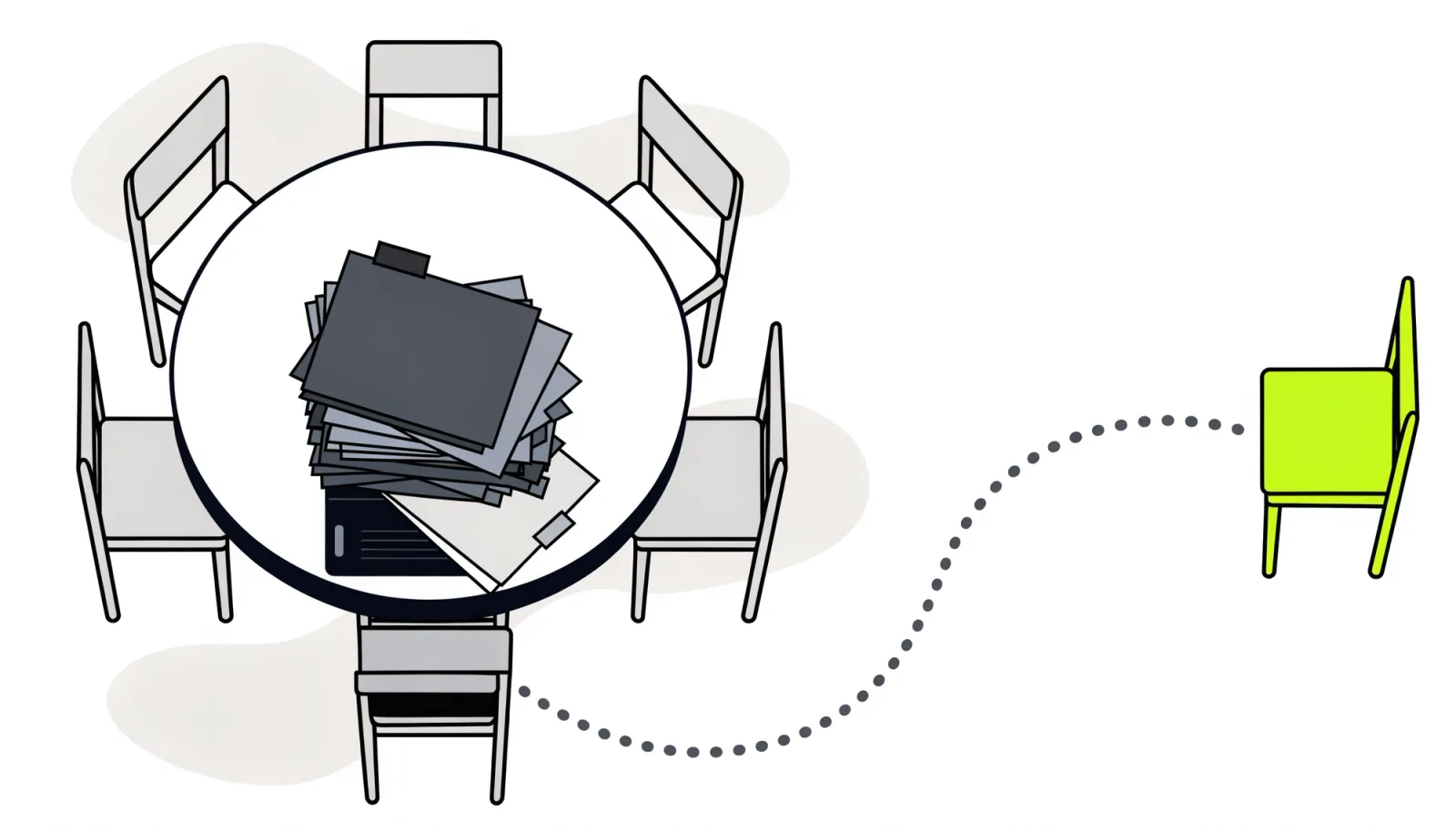
We think a deal should keep moving while its champion’s team is in its busy season. That happens only when the multi-threading is planned before the season starts. It doesn’t happen by default. Reps stay with the contact they know. A champion in the middle of an annual bid or a peak has no time to bring anyone else in.
The other seats keep their own calendars. While the champion’s team is buried, finance and the budget owner may be setting next year’s budget. So the dark weeks can be a good time to reach those seats, if the plan says who reaches each one and by when.
The data points the same way. In Gong’s analysis of 1.8M deals, multi-threading lifted win rates by 130% on average in deals over $50k↗. Across 655,000 opportunities, win rates rose 55% when decision makers were actively involved in the first 2 stages↗. And about 40% of buyers join the buying group from outside the department that will use the product↗.
Today’s AI answers get partway there. ChatGPT tells sellers to keep “nurturing other stakeholders” through the season, and Google’s AI Overview names the CFO and procurement↗. Neither answer gives each seat an owner on the seller’s side and a date of its own↗. Nor do the 2 pages answer engines cite for this question↗.
We don’t say every seat needs equal attention, or that more threads alone win the deal. The seats that matter to the decision need an owner and a date. The rest can wait for the champion.
Plan the seats the busy season leaves open, before it starts
Plan the busy season as a stretch of the deal with its own dates, and do it before the window opens. A seat is a role in the buying group, such as finance or IT, however many people fill it↗.
- 01Step 1
Date the window
Ask the champion when their team’s busy season starts and ends. Store both dates on the account, so every account has its own.
Before the window - 02Step 2
Agree the restart
In the last call before the window, agree when to pick up again, which seats you may work with meanwhile and who introduces you first.
Just before it opens - 03Step 3
Name the open seats
List the required seats outside the champion’s team that keep their own calendar, usually the budget owner, finance and IT.
Before it opens - 04Step 4
Give each seat an owner and a date
A person on your side who can answer the seat’s first question, a small first ask and an engage-by date inside the window. The budget owner goes first.
Inside the window - 05Step 5
Count engaged seats weekly
Review coverage by tier every week, starting from missed engage-by dates. The champion’s seat shows its restart date.
Every week - 06Step 6
Restart with what moved
On the agreed date, send the champion a short written summary of each seat, then pick the deal up together.
Restart date
The last call before the window matters most. Ask the champion 3 things: when to pick up again, which seats you may work with while they’re away and who should introduce you first↗. That makes the plan theirs. Working with finance or IT is then part of what you agreed together.
Each open seat gets an owner on your side who can answer its first question↗. Your account executive takes the budget owner, a solutions engineer takes IT and a finance lead takes finance. A small team can give the finance seat to a founder. In Gong Labs’ analysis of 10,332 deals, win rates rose from 15% with no team selling to 50% with 3 or more seller-side roles involved↗. That is a correlation rather than a controlled test.
Win rates rise from 15% to 50% when 3 or more seller-side roles work the deal.
Data behind this chart
| Item | Value |
|---|---|
| No team selling | 15% |
| 3 or more seller-side roles | 50% |
Keep each first ask small and specific to the seat. Ask the budget owner whether this is in next year’s plan, and what it would have to prove. Ask finance which numbers a business case must use. Ask IT about its roadmap and what you would have to connect to.
If the season has already started, reach the budget owner first, this week. Then send the champion a question that takes a line to answer, such as whether the restart date still holds. A written reply to a question you asked counts as a two-way exchange↗.
Count engaged seats every week the champion is away
Count engaged seats, not touches, every week of the window. Coverage is engaged seats divided by required seats, per open deal and per account↗↗. A seat is engaged after a two-way exchange with its holder in the last 90 days↗. That means a call, a meeting or a written reply to a question you asked. Opened emails, webinar visits and the champion’s account of a meeting don’t count.
That rule shows the risk plainly. A champion who stays silent for longer than that drops out of the count. A deal that ran through them alone then has no engaged seat left. So during the window, show the champion’s seat with its restart date and report coverage on the open seats beside it↗.
Each week, review 3 numbers per tier: open seats engaged, open seats past their engage-by date and accounts with no open seat engaged↗. Start the review from the missed dates, oldest first. A missed date needs a new route as well as a new date. Try an introduction from a customer in the same role, or your own executive for an executive seat↗. At the restart, compare coverage with the day the window opened and with the same weeks last year. Without that baseline, any number can look like progress.
What does a busy-season seat plan look like for 400 named accounts?
For a fictional TMS vendor with 400 named shippers, the plan comes to 144 open seats in a 13-week freight bid, about 11 a week↗. The vendor has 4 account executives, and its mid-market shippers buy on 9-month cycles↗. By our estimate, a mid-market TMS deal runs at €27–107k a year, and 6–13 people decide it at a mid-size shipper↗. IT and finance settle whether the old system goes↗.
The vendor tiers by capacity: 48 Tier 1 accounts (12 per seller), 160 Tier 2 (40 per seller) and 192 Tier 3↗. Each Tier 1 account has 4 required seats, 192 in all↗. The champions, the transport managers, run the bid from mid-September to mid-December, and each account’s own dates sit on its record↗. When the window opens, 54 of the 192 seats are engaged (28%), and 36 of them are champions↗.
| Seat at a Tier 1 shipper | In the bid | Owner at the vendor | First ask | Engage by |
|---|---|---|---|---|
| Transport manager (champion) | Dark | Account executive | In the last call before the bid: when to pick up again, the seats to work with and a first introduction | Restart in week 14 |
| VP logistics, VP supply chain or COO (budget owner) | Open | Account executive | Is a TMS replacement in next year’s budget, and what would it have to prove? | Week 4 |
| IT and ERP lead | Open | Solutions engineer | The ERP roadmap and every system a TMS would connect to | Week 8 |
| Controller or CFO | Open | Finance lead | Which freight and labour numbers a business case must use, and from which reports | Week 11 |
| Transport procurement, where it runs the bid | Dark | Account executive | None until the award | After the restart |
Each account executive reaches 12 budget owners by week 4, 3 a week↗. The budget owner goes first because next year’s budget may still be open. A solutions engineer takes the 48 IT and ERP leads by week 8, 6 a week↗. A finance lead takes the 48 controllers by week 11↗.
Tier 2 gets 1 open seat, the budget owner, through a written note from its account executive↗. Tier 3 gets content until a signal moves it up.
The target is 2 of the 3 open seats at every Tier 1 account by the restart: 96 seats↗. With the 36 champions back on their restart dates, Tier 1 coverage would be 132 of 192, about 69%, against 28% when the window opened↗.
Which signals open a project before the RFP lands?
Dated, company-level events with a public source open a project before the RFP↗. Examples are a new leader in the seat that chooses and a cluster of related job posts↗. Waiting for the RFP is late: buyers choose a vendor from their Day-One shortlist 95% of the time↗. And 52% of buyers lean on analysts, consultants or agencies↗. Treat the adviser who writes the shortlist as a seat, with an owner and public evidence it can check.
Act on each signal the same day. Pair it with the seat it opens and give it to the account’s owner as a task with a single action. The first human touch is due within 1 working day↗.
For a TMS, each signal buyers ask about opens a different seat. Routing-guide failure, when tender rejections rise and the shipper rebids outside its annual bid, opens the transport manager’s seat↗. A new supply chain VP opens the budget owner’s. An ERP move opens IT’s, whose worry is a TMS migration on top of an ERP migration↗. SAP’s mainstream maintenance for the core applications of SAP Business Suite 7 runs to the end of 2027, with optional extended maintenance to 2030↗.
The busy season is a source too. At the restart, ask the champion what the season cost their team and where today’s process broke. Write the answer on the account: it is a dated signal from the person closest to the problem.

In practice
How we do it at Panelhop
In a Panel Check (GTM audit · 2–3 weeks), we baseline buying-group coverage on your target accounts from your own CRM records: the seats engaged per account and per open deal and, where your activity history allows, how coverage changed through last year’s busy season. Leak Fix (we build the fixes) then puts each account’s busy-season dates and restart date on its record in HubSpot or Salesforce. It adds the seats each tier requires, an owner and an engage-by date for every open seat and a weekly coverage report.
With Signal Desk (in-market accounts, weekly), an account that shows a signal arrives in your CRM with the seat it opens and a brief your rep approves before anyone is contacted. Everything is documented in your own accounts, so the plan outlasts whoever built it.
Questions buyers ask about this
We sell TMS to about 400 named mid-market shippers. ABM or inbound: which works on 9-month cycles when their transport teams disappear into the freight RFP season every autumn?
ABM, with inbound written for the seats you’re working. Tier the list by what your account executives can work, then plan the bid weeks seat by seat: the budget owner, finance and the IT and ERP lead, each with an owner on your side and an engage-by date. Inbound earns its place as the pages those seats read without a meeting, and as a signal when several people at a single named shipper read them.
We only hear a shipper is replacing its TMS when the RFP lands and a consultant already has a shortlist. Which buying signals show up 6–9 months earlier, like routing-guide failure, a new supply chain VP or an ERP move, and how do we act on them?
Those are the right signals to track, along with mergers, new sites and an incumbent’s price change. Pair each one with the seat it opens and give it to the account’s owner the same working day, with a single action. Treat the selection consultant as a seat too, with an owner and public evidence it can check before it writes the shortlist.
Isn’t working with finance or IT while the champion is busy going around them?
Not if you agree it with them first. In the last call before their busy season, ask which seats you may work with while they’re away and what they want to hear about each when they’re back. On the restart date, send them a short written summary of what moved.
What if every account’s busy season falls at a different time?
Plan from each account’s own dates, stored on its record, and ask the champion for them at the next touch. Some teams also work outside their main season: a shipper rebids when its routing guide fails. So check the dates again at every restart.
What counts as an engaged seat?
A seat counts as engaged after a two-way exchange with its holder in the last 90 days: a call, a meeting or a written reply to a question you asked. Opened emails, webinar visits and the champion’s account of a meeting don’t count. So a champion who stays silent through a season longer than 90 days drops out of the count until the restart.